Submit a thread to our digital quilt for the chance to be featured in an exhibition and win £200. Learn more

Category: Uncategorized

Commonwealth Civil Society Forum on Health

The Commonwealth Health Ministers Meeting (CHMM), held on 20 May 2018, provided an opportunity for member countries to share their experiences and lessons learned, as well as build consensus around collaborating to enhance the global fight against non-communicable diseases (NCDs). It also addressed suggestions for effective funding models for universal healthcare (UHC).

Civil Society Forum

Working in collaboration with members of the Commonwealth Health Professions Alliance (CHPA), and in partnership with Oxfam GB, the Commonwealth Pharmacists Association (CPA) contributed to a successful Civil Society Forum (CSF) on the eve of the annual CHMM in Geneva.

The Forum entitled ‘Universal Health Coverage (UHC): holding countries to account’ followed on from discussions hosted by civil society on the same topic during the previous month at the Commonwealth People’s Forum (CPF). The afternoon saw seven speakers delivering thought-provoking presentations before engaging in lively discussions with delegates from all over the Commonwealth. The working descriptor for the session was:

‘everyone agrees UHC is a good thing, and governments have committed to UHC as part of the Sustainable Development Goals (SDGs). But UHC cannot be achieved without sustainable financing, a sufficient health workforce, and equitable access to safe, quality, and affordable medicines for every citizen’.

The CPA co-ordinated the health workforce section of the afternoon’s programme. Seven recommendations drafted after the CPF in London the previous month were further refined as a result of expert input and discussions. These were presented by the CHPA to the Commonwealth Health Ministers at CHMM the following day.

https://twitter.com/FIP_org/status/998515018667909123

The CHPA also conducted a survey via their networks to request feedback on these recommendations from a wider audience. As a result of this, further refinement was achieved and the CPA was delighted that recommendation three (below) specifically referenced the need for governments to not only address ‘access to effective, quality and affordable essential medicines’ but also recognised the essential role pharmacy plays in this aspect of achieving UHC by specifically highlighting the need to invest in developing a ‘sufficient pharmacy workforce’:

 Recommendation 3: that Commonwealth governments include in their UHC plans strategies for:

  • Access to safe, effective, quality and affordable essential medicines and vaccines for their populations
  • Building capacity through education and training for a sufficient pharmacy workforce
  • Developing public procurement policies using public financing

Thank you to everyone that responded to our requests to answer the survey – your collective voice certainly made an impact and strengthened our advocacy efforts. We look forward to the next steps in these discussions. The full set of recommendations and presentations from the CPF are available on the CHPA website. ( www.chpa.co )

Commonwealth Health Ministers Meeting

The theme for the CHMM this year was, ‘Enhancing the global fight against NCDs; raising awareness, mobilising resources and ensuring accessibility to UHC’. The meeting began with opening remarks by the Chair, Hon. Rosy Sofia Akbar, Minister of Health, Fiji and the Rt Hon. Patricia Scotland QC, Commonwealth Secretary-General. Following this, Mrs Graça Machel DBE, co-founder of The Elders delivered the keynote, where she referred to the ‘fundamental right of health and well-being for all’, as an essential component for vibrant communities and the development of nations. After lunch Dr Tedros Adhanom Ghebreyesus, World Health Organisation Director-General continued these discussions in the same vein, focusing on the importance of Commonwealth collaboration in enhancing the global fight against NCDs in the context of UHC.

The Commonwealth Health Ministers engaged in discussion and debate throughout the day around challenges affecting their nations as they strive to make SDG3 and UHC a reality for their populations. There was particular emphasis on measures to encourage environments where healthy diets and exercise would promote wellness and help tackle the NCD epidemic through prevention.

The UK’s Secretary of Health and Social Care, Rt Hon Jeremy Hunt reiterated the British government’s commitment to health outlined in the 2018 CHOGM Communique, part of which was directly linked to and provided a basis for the programme of the CSF the previous day:

‘Commonwealth Heads agreed to achieve compliance with International Health Regulations, accelerate UHC, including through sustainable financing, strengthening health systems and integrated services which promote prevention, screening, diagnosis, treatment and palliative care. Heads also recognised the need to tackle antimicrobial resistance and noted with concern the proliferation of substandard and falsified medical products which contribute to antimicrobial resistant and drug resistant infections.’

The CPA were most encouraged that our advocacy efforts leading up to CHOGM were reflected in the commitment of CHOGM to tackle both AMR and the rise of substandard and falsified medicines.

The full CHOGM Communique can be viewed here. The full statement from CHMM will also be available on the Commonwealth’s website shortly.

Victoria Rutter is Executive Director at the Commonwealth Pharmacists Association. 

Marking memories at the Migration Museum

‘We are here because you were there’, declare black words on a yellow banner hanging from the ceiling at the Migration Museum in Lambeth, London – the location of the launch of We Mark Your Memory: Writing from the Descendants of Indenture  to which I’m delighted to be a contributor.

The words of A. Sivanandan – the late, great novelist and director emeritus of the Institute of Race Relations – could not be more poignant to the times we are living in and to the stories collected in the anthology. We Mark Your Memory is edited by David Dabydeen, Maria del Pilar Kaladeen and Tina K. Ramnarine, and is published by the School of Advanced Study in conjunction with Commonwealth Writers.

The Museum was the perfect location for the launch – a hidden gem filled with relics and memories of the extraordinary migratory journeys that humans have made across the world, and the racism and discrimination they have experienced. There are miniature models of multi-coloured boats and ships symbolising journeys made; there are records of the Rock Against Racism rallies and gigs; there is wonderful artwork and painting expressing migration.

It was against this fitting backdrop that speeches about the anthology from its editors and the Director-General of the Commonwealth Foundation, and six readings from the anthology, took place.

‘A collective act of resistance across time and space against having to explain to people their own British history’ and ‘a claiming of our identities internationally’, is how Maria del Pilar Kaladeen described the anthology. We Mark Your Memory commemorates the centenary of the abolition of the system in the British Empire (2017–20) by gathering, for the first time, new writing from across the Commonwealth that explores indentured heritage through fiction, essays and poetry.

‘What exactly is indenture?’, I am often asked by those brave enough to ask at all; others stare blankly when I mention the word indenture, assuming it’s something to do with teeth. And so I must explain the little-known system of nineteenth- and early twentieth-century Indian migration under the British Empire. Thankfully, I can now hand curious people a copy of the anthology. The abolition of slavery was the catalyst for the arrival of the first indentured labourers into the sugar colonies of Mauritius (1834), Guyana (1838) and Trinidad (1845), followed by the inception of the system in South Africa (1860) and Fiji (1879).

Indenture, whereby individuals entered, or were coerced, into an agreement to work in a colony in return for a fixed period of labour, was open to abuse from recruitment to plantation. Often-harrowing stories of exploited and unfree workers and their descendants are captured between the covers of the book. These include indentured histories from Madeira to the Caribbean, from West Africa to the Caribbean, and from China to the Caribbean, Mauritius and South Africa.

By the time indenture was abolished in the British Empire (1917–20), over one million Indians had been contracted, the overwhelming majority of whom never returned to India. Today, an Indian indentured labour diaspora is found in Commonwealth countries including Belize, Kenya, Malaysia, Sri Lanka and the Seychelles. There was a wide variety of geographical backgrounds represented in the six contributors who read:  Prithiraj R. Dullay read from ‘My Father the Teacher’, myself from ‘Escape from El Dorado: A Bittersweet Journey through my Guyanese History’; Fawzia Muradali Kane from ‘I go sen’ for you’; Gitan Djeli from ‘Mother Wounds’; Eddie Bruce-Jones from ‘india has left us’; and Priya N Hein from ‘Paradise Island’.

Finishing the readings, we were treated to a recital by acclaimed poet and writer Maria del Pilar Kaladeen of his first published poem in 23 years, ‘Pot-Bellied Sardar’, dedicated to his fellow editors. Amongst those celebrating the launch was esteemed poet John Agard. All in all, it was a most moving and memorable evening launching into the world an important book which sheds light on why we are here.

Access the full collection of images from the launch here.

Anita Sethi is a journalist and contributing writer to We Mark your Memory.

The value of a thousand narratives: reflections on the Commonwealth People’s Forum 2018

There I was, pacing the streets of one of the most impressive cities in the world. I was running late for an 8am meeting with a half-filled stomach, and my only concern was making sure I was well prepared.

For what? One of the most important political events on the Commonwealth calendar. More than 350 delegates from Commonwealth nations representing civil society were about to convene at the Queen Elizabeth II Centre in central London for the Commonwealth People’s Forum 2018.

Civil society is one of the biggest pillars of democracy. Through civil society those who have been repressed, violated, silenced and erased find a channel where they can tell their side of the story and hold governments to account for their commitments or lack thereof. Civil society is all about creating an enabling space for dissent which encourages multiple voices to be involved in policy-making processes. The governments may have the power, but the people collectively have a voice and policies that can be used to develop innovative solutions to some of the world’s most pressing development problems. Therefore, it’s very important that as many people as possible can be involved in creating solutions and as the saying goes ‘if you’re not around the table, you’re on the menu’.

A delegate asks a question during a panel on Legislative Reform in the Commonwealth
Photo©vickicouchman

For as far as I can remember I’ve always been an advocate for inclusion. When I’m not fighting for women’s rights to be recognized and a space to be created for them in political and economic processes, I’m challenging a system that has seen many young people being locked out of politics and other decision-making processes. So as per my self-appointed role, I was ready to scan the room and make notes on who had been left behind at this auspicious event.

‘The governments may have the power, but the people collectively have a voice and policies that can be used to develop innovative solutions to some of the world’s most pressing development problems.’

The opening could not have been more perfect. Ben Okri offered a satiating talk that allowed us to clean the palettes of our minds and hearts in preparation for the forum ahead. I say this because most of the time, especially when you have been to similar settings numerous times you start to feel that they are all the same. We start to look forward to the mistakes and what could have been done better instead of opening up ourselves to the possibility of having life and nation changing conversations.

Acclaimed author and poet Ben Okri opened the forum with a keynote on ending exclusion in the Commonwealth
Photo©vickicouchman

Many of us have struggled with the idea of a Commonwealth. The name suggests a common and shared wealth but this can be misleading considering that many of the citizens within these nations live below the poverty line. So what then is common amongst us? Mr Okri made me realise that what is common is our history and history has an invaluable amount of wealth, because of this we share a common story of how our nations came into being. We share a common language and also share similar future prospects.

‘The Commonwealth People’s Forum represented a dinner where everyone I could think of could be found at the table and for once instead of having the poor and marginalized on the menu, we had issues of corruption, sexism, racism and gender inequality to discuss.’

The Commonwealth People’s Forum was filled with people from all spectrums of life. Those who have attended many forums and those who were attending it for the first time. Like myself. Those who cared about the wellbeing of the elderly to those who were defending LGBTQI rights. Listening in on every session I got to walk in the shoes of the panelists as they shared their stories. This gave me a valuable insight on the challenges of inclusion and injustice others were facing across the Indian and Pacific Ocean.

From left to right: Patrick Younge, Rod Little, Rosanna Flamer-Caldera and Marchu Girma
Photo©vickicouchman

I always say the personal is political. Politics is not a choice. Often we use ourselves as the point of reference for our activism but this narcissistic approach to dissent can be reckless. The Commonwealth People’s Forum made me appreciate the value of a thousand narratives.

I come as one but stood for thousands that are unemployed in the Southern African Development Community (SADC). I speak for women that are violated and marginalised culturally, economically and politically. Making sure that the experiences and voices of all the ten thousand people and more that I represent are acknowledged is important to me. This made me notice another magical thing about the Commonwealth. We are a kaleidoscope of different hues, views, cultures and beliefs that are in conversation with one another. The Commonwealth People’s Forum represented a dinner where everyone I could think of could be found at the table and for once instead of having the poor and marginalised on the menu, we had issues of corruption, sexism, racism and gender inequality to discuss. Together we created solutions that have the power to drive the Commonwealth nations in the direction that the rest of the world should be going in.

Ian Mangenga is a youth activist and member of the South African chapter of the Southern African Alliance for Youth Unemployment

Commonwealth People’s Forum 2018: a case for renewal

2012 brings the Foundation back to the beginnings of its call for the renewal of the Commonwealth.

When the Foundation was re-launched in 2012 and given the mandate to support people’s participation in governance across the Commonwealth, the Commonwealth People’s Forum (CPF) was re-aligned to support this mandate.

In 2013 the CPF in Colombo, Sri Lanka contributed to the architecture of the Post 2015 Development Agenda and advocated primarily for gender equality and women’s empowerment as a stand-alone goal. That today is Goal 5 in the 2030 Agenda for Sustainable Development. The Malta Declaration on Governance for Resilience was the result of the conversations in CPF2015.

Even as CPF anchors itself in the prevailing development discourse, it does so by offering counter narratives, challenging dominant paradigms and giving meaningful access to voices in the margins. In Malta, CPF2015 offered the governance lens to the discourse of resilience, which until then was analysed only within an economic and environmental context.

‘CPF2018 interrogated the issues of exclusion in the Commonwealth, sessions took on injustice as experienced by people in all their diversity and tackled accountability in governance.’

It was also in Malta where the Commonwealth Heads of Government recognized the consonance of the work of the Foundation with SDG 16, the shorthand of which is Peace, Justice and Strong Institutions.

These are the building blocks of CPF2018. In 16 April 2018, the Commonwealth Foundation in partnership with the UK Government opened the doors of Queen Elizabeth II Conference Centre in London. It did so with defiant hope that renewal in and of the Commonwealth is indeed possible.

CPF2018 interrogated the issues of exclusion in the Commonwealth, sessions took on injustice as experienced by people in all their diversity and tackled accountability in governance. The forum pressed on to come to an understanding of the imperatives of a renewed Commonwealth. At the end of three days, civic voices crafted the London Declaration on Inclusive Governance for a Renewed Commonwealth with an accompanying Call to Action.

The Declaration and the Call to Action argue that Commonwealth renewal is no longer an option, but an achievable imperative. Civic voices concluded:

‘We stand at the threshold of a new Commonwealth future, built on equality, diversity, a constant questioning, and interrogation of the constraints and challenges that face us and the opportunities, strengths and values that unite us as human beings with shared stories.

We will achieve this through common effort, shared experience, action with vision and imagination, and by building inclusive, participatory, responsive and accountable systems of governance that leave no-one behind.’

In these perilous times, now more than ever civic voice matters. And it is with a buoyant optimism that the Foundation will persist with its commitment to support the call for the renewal of the Commonwealth for the interests of civic voices.

More voices for a fairer world.

The CPF2018 Declaration and Call to Action cover 13 key policy areas:

  1. Reforming colonial-era laws
  2. Accessing justice
  3. Rights of indigenous peoples
  4. Women negotiating peace
  5. Migration
  6. People centred health and education
  7. Climate justice
  8. Just world order and just economies
  9. Digital age, one that enables but also protects the peoples of the Commonwealth
  10. Separation of powers
  11. Accountability in development
  12. Decentralising power
  13. Media accountability

Myn Garcia is Deputy Director-General of the Commonwealth Foundation. 

EDITOR’S NOTE: A newsletter item which was hyperlinked to this article and circulated on 30 April 2018 incorrectly identified Myn Garcia as Director-General of the Commonwealth Foundation.

Ben Okri’s electrifying keynote on ending exclusion

Inclusion is at the heart of Sustainable Development Goal 16, but exclusion has become accepted across the Commonwealth.

How can institutions and civic voices ensure that inclusion, rather than exclusion, becomes the norm?

Ben Okri, one of Africa’s foremost authors and poets, opened the Commonwealth People’s Forum 2018 with an address on how civil society can breathe new life and purpose into the Commonwealth by ending exclusion. View his electrifying keynote below.

Commonwealth People’s Forum 2018 in pictures

Award-winning photographer Vicki Couchman provided photo coverage throughout the three days of the Commonwealth People’s Forum 2018.

The pictures are now available for download in high resolution from the Foundation’s Flickr and Facebook pages.

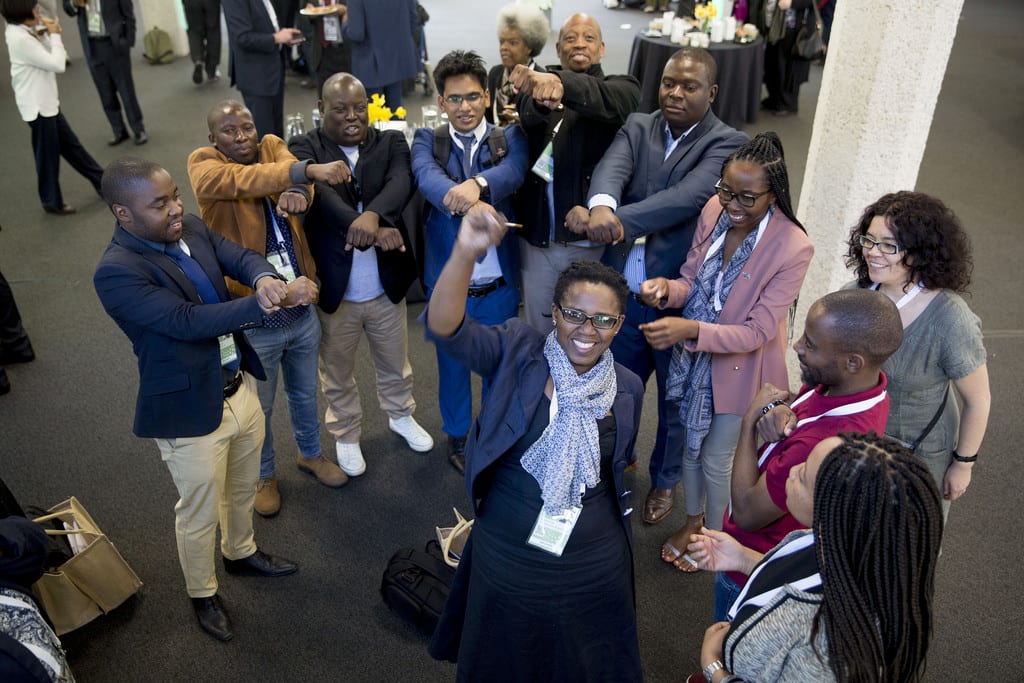
Members of the Southern African Alliance for Youth Employment and other delegates at the Forum. Photo©vickicouchman
Theresa May speaking at the all-forum plenary, Toward a Common Future.
Photo©vickicouchman
Marai Larasi speaking in the Institutional Racism panel on day 1 of forum
Photo©vickicouchman
HRH Prince Charles joined the forum to meet civil society activists and writers
Photo©vickicouchman
Poetry by Melizarani T. Selva, Kendel Hippolyte and Karlo Mila during the opening ceremony of the forum
Photo©vickicouchman
Hazel Brown and Vijay Krishnarayan during the closing address of the forum
Photo©vickicouchman

Continue to the full collection and free downloads 

Poem for the Commonwealth 2018 by Karlo Mila

We gather here
and feel the weight of the world
on our shoulders.
It does not feel like
we’ve inherited
commonwealth.
But rather
common problems.

If we are to heed the words of poets
Ben Okri said yesterday,
“We have entered the garden
of nightmares and wonders
the giants have woken
and they are stirring
we need to be roused
from the beauty
of our sleep.”

Indeed, we’ve entered this
strange garden
in this city,
epicentre of epitaph,
epitome of empire.

The stones in the squares
remind us
that we all died for this.
The war memorials murmur
numbers not names.

We bring our dead with us
and they are already here.

Not just the ones marked by marble.
But our ancestors,
the original inhabitants
of the lands ‘discovered’.
Who lie in the unmarked graves
and unmentioned massacres,
in battles unspoken of
in untaught wars

We carry them like stones
in our bodies.

They too contribute
towards this commonwealth.
They gave more
than they should have.

Commonwealth.

We come with twinned sides
of the same story.
Either trauma or gain.

Both of it pain.
Two sides
of the same coin,
heads or tails,
the head is the same
on most of our money.

The commonwealth.
Some days
it does not feel like riches,
Although we gather
to speak
of fairer futures.

Truth be told,
It is the fear of future
that we most have in common.

I did not come to sing a siren song
on the sinking ship of empire,
I come to sing of sinking islands
in the South Pacific,
on the blue continent
where I come from.

What is at stake,
Is the very land we stand on.
The earth itself rejects us.
It renegs its responsibiliities.
It has retreated
back into the deep.

And if the ocean could speak
in that choked overheated throat
gagged with plastic bags
in the way she once spoke to us
and we could listen,
she would say,
too much salt on her tongue,
she would say

rising with a surety
that we have never seen before,
she would say,
ENOUGH!

Continue reading…

So Many Islands: an anthology of stories from the Caribbean, Mediterranean, Indian and Pacific Oceans

Marlon James, winner of the 2015 Man Booker Prize, writes in his introduction to So Many Islands that the collection represents ‘real globalism’: ‘a glorious cacophony that seeks no common ground other than attitude. Stories and poems that exist in no other context than their own, characters who owe only to themselves, and writers who write with nothing hanging on their backs’.

Underlying these resolute words are the paradoxes of island living which James’s introduction continually emphasises: that the sea and the sky are at once ‘definers and confiners’; that ‘to be island people means to be both coming and going’.

So Many Islands—a collection of poetry, prose and non-fiction from the Caribbean, Mediterranean, Indian and Pacific Oceans—comes out of Commonwealth Writers’ work in the regions and has been developed alongside their partners. The anthology emerged from three aims: to animate the challenges facing islands, to provide platforms for less-heard narratives, and to offer development opportunities for emerging writers. Thirty of the nations of the Commonwealth are islands, and the project was evidently timely and required, soliciting responses from over 300 writers responding to an open call for stories, poems and essays.

Reflecting the simultaneous connection and separation of island geography, So Many Islands is published in three editions, by three presses, in three regions of the globe. In the Caribbean, US and Canada, it is available from Peekash Press. In Australia, New Zealand and the Pacific Islands, it is published by Little Island Press. And in the UK and Europe, it is published by Telegram.

In his foreword to the collection, editor Nicholas Laughlin notes how the stories ‘speak to each other across oceans. Their stories, their insights, their arguments, their jokes, their memories and their questions travel far on unceasing tides’. Such oceans have been crossed for the ten launches So Many Islands has prompted, arriving in Barbados, Bermuda, Fiji, Jamaica, New Zealand, Samoa, St Lucia, Trinidad and Tobago and, most recently, the UK. Co-editor Nahila Folami Imoja, reviewing the Barbados launch, discusses the ‘ripple effect of good literature’. Her aquatic metaphor, together with constant turns to the ocean in So Many Islands, reminds us that, in Laughlin’s words, the ‘very sea that insulates and isolates’ islands is also ‘the medium that connects’.

As the pieces in So Many Islands cross oceans, they also cross genres, forms, themes and voices. In the anthology, you will find love poems and protest poems, stories of innocence and innocence lost, and narratives of departure and return. There are pieces that tackle traumatic histories – from the aftermaths of transatlantic slavery to nuclear testing in the Pacific – alongside a delicate exploration of budding sexuality in Singapore, a comic account of a cricket match that becomes a drama of personality, and a lyrical return to a Pacific island guarded by four female deities.

James’s introduction references the legacies which ‘take [islands’] resources away’; So Many Islands showcases the rich literary resource in which writing from islands shares. ‘It takes a big mind, or at least a big worldview, to write from a small island’, he says. ‘Everything we write stands one foot on land, the other in the sea. We can’t help it: we’re from where the air is clear, so it’s almost impossible to think small’.

Bocas Lit Fest has produced podcasts with some of the Caribbean authors—Angela Barry, Tracy Assing, Heather Barker, Jacob Ross and Melanie Schwapp. They can be heard here:
https://soundcloud.com/bocaslitfest/sets/so-many-islands

Will Forrester is an Intern for Commonwealth Writers.

The spirit of solidarity at the Commonwealth People’s Forum 2018

Ben Okri, renowned writer and poet, calls on citizens to ‘Wake up. Unveil your eyes, ask questions, use your power.’

Citizens are, he says, living units of democracy, ‘a living force for all the possibilities of this world. Of all the qualities, the one I most value in the citizen is not political savvy, or high education, but awareness.’

Mr Okri will kick off three days of the Commonwealth People’s Forum 2018 (CPF 2018) deliberations, debates, and dialogues in just this vein with his keynote address. Over 16, 17 and 18 April 2018, the importance of ‘awareness’ and the power of civic voice in the Commonwealth will be examined in panels on various current issues.

All debates at CPF 2018 will amplify less heard voices. Narratives of people in the margins from around the world will be spoken, shown, seen and heard. Action will be demanded to address marginalization, and delegates will remember that they do not walk alone in their struggles to create a better world.

Other speakers of note include:

  • Miriam Coronel Ferrer and Olga Amparo from the Philippines and Colombia, respectively, talking about their lived experiences and exploring the challenges for women involved in peace processes in Women Negotiating Peace
  • Kim Barrow, the First Lady of Belize and Caleb Orozco an LGBT activist for many years, will discuss Belize’s successful legislative reform around same-sex relationships in Legislative Reform in the Commonwealth
  • David Archambault, former tribal Chairman of the Standing Rock Indian Reservation in North Dakota and Daniel Kobei from Kenya’s Ogiek indigenous minority debate the systemic discrimination to the rights of self-determination for indigenous people in Indigenous Rights and Self-Determination
  • Faiza Shaheen, Director the Centre for Labour and Social Studies, named Observer Rising Star for Campaigning in 2017 and P. Sainath, former Rural Affairs Editor of The Hindu debate how we can make the global economy more just in Just Economies
  • Priyamvada Gopal, deeply involved in the campaign to decolonize the university curriculum in the UK, talks in Persistent Resistance

CPF 2018’s main theme is: Inclusive Governance: Can the institutions of the Commonwealth renew themselves to be inclusive, just, and accountable? Each day will explore three subthemes: exclusion, justice and accountability.

We hope that delegates at CPF 2018 will feel the embrace of solidarity in full measure as we ask difficult questions of ourselves and as we engage in technical chatter and substantive discussions. We say to all our delegates what speaker Felogene Anumo says to young feminists: ‘The future belongs to us.’

These questions would have found direct and brave answers in the voice of Asma Jehangir, the stalwart lawyer-activist from Pakistan, had she been able to attend CPF 2018 as planned. Instead however, we will mourn her recent untimely death, and pay tribute to her indefatigable spirit which persisted in the face of arrest, death threats, court cases, and assaults. She said a few years ago: ‘There have been times I have been scared. There have been times that I have cried. But does that mean you give up …? No, never!’ Asma truly embodied Ben Okri’s idea that ‘We can redream this world and make the dream come real. Human beings are gods hidden from themselves.

Shobha Das is Project Manager at Commonwealth People’s Forum 2018. Photo credit: Find My Feet

The power of stories at the Commonwealth People’s Forum 2018

Gaiutra Bahadur’s essay in We Mark Your Memory, a forthcoming anthology of writing by descendants of indenture, segues from Britain’s exit from the European Union into an exploration of her Guyanese great-uncle’s identity: a grandchild of indentured labour and an economist at the Commonwealth Secretariat.

This connection comes as Bahadur considers an increasingly pressing question: ‘How are we, actually, joined? And what kind of joining matters?’. Bahadur’s query is timely; it is a timeliness mirrored in the heading of the 2018 Commonwealth Heads of Government Meeting (CHOGM) in London: ‘Towards a Common Future’.

In the run-up to CHOGM, the Commonwealth People’s Forum 2018 (CPF 2018) brings together civic voices from around the world to debate such queries facing a contemporary Commonwealth. Echoing the focus of CHOGM, CPF 2018 asks three questions: what would an inclusive Commonwealth look like? how can we ensure justice? and what are the imperatives for an accountable Commonwealth? These questions share similarities with the crux of Bahadur’s essay: ‘What kind of joining matters?’.

‘How are we, actually, joined? And what kind of joining matters?’

During CPF 2018 events curated by Commonwealth Writers, artists and writers will use varied forms of creative expression to ask these questions. Thirteen writers will read from two Commonwealth Writers publications which, while not directly envisaged in relation to the Forum’s themes, are underpinned by notions of inclusion, justice and accountability. The first is We Mark Your Memory, which features poetry, fiction and essays based on indentured legacies in the Chagos Islands, Fiji, Guyana, Liberia, Malaysia, Samoa, Sri Lanka, St Vincent and the Grenadines and Trinidad and Tobago . The second is So Many Islands, an anthology of stories from the Caribbean, Mediterranean, Indian and Pacific Oceans. Both collections, at their heart, look at the ways in which we are joined.

In his foreword to So Many Islands, editor Nicholas Laughlin comments that the sea, which ‘insulates and isolates’ islands, is at once the force which ‘connects’. Indeed, by the start of CPF 2018, So Many Islands will have traversed these connections for its launches in Barbados, Bermuda, Fiji, Jamaica,  New Zealand, Samoa, St Lucia, Trinidad and Tobago, and the UK. So too in We Mark Your Memory writers from diverse and broad spaces are connected by joint legacies and common futures; as the collection moves between geographies, histories and genres, transoceanic links are revealed in unexpected ways. Both anthologies urgently demonstrate how creative expression and civic voices have a fundamental role to play in ensuring that our common future is inclusive, fair and accountable. The events at CPF 2018 hosted by Commonwealth Writers reflect this capacity, integrating rather than supplementing panel discussions and policy dialogues.

‘Amidst global uncertainty, creative endeavours hold the agency to both attest to the histories of diverse global identities and to ensure a renewed Commonwealth in which we are joined in equitable, just and vociferous ways.’

The format of the readings at CPF 2018 embody the connected spaces of the collections. Tracy Assing (Trinidad and Tobago), Angela Barry (Bermuda), Cecil Browne (Saint Vincent and the Grenadines), Kendel Hippolyte (Saint Lucia), Erato Ioannou (Cyprus) and Karlo Mila (Tonga) will read from their contributions to So Many Islands, and David Dabydeen (Guyana), Prithiraj Dullay (South Africa), Gabrielle Jamela Hosein (Trinidad), Fawzia Muradali Kane (UK), Gitanjali Pyndiah (Mauritius/UK), Mary Rokonadravu (Fiji) and Anita Sethi (UK) from their pieces in We Mark Your Memory.

These sessions comprise ‘intimate readings’, conducted in promenade, in which delegates walk from author to author, and in doing so experience and map the connections which join them. Commonwealth Writers will also open the CPF 2018 with a short film featuring definitions of ‘inclusivity’, ‘justice’ and ‘accountability’ by individuals across the Commonwealth. In a very literal sense, this film acts to amplify civic voices on a global stage. Finally, a session titled ‘Persistent Resistance’ will bring into dialogue music from members of the Nigerian floating radio station Chicoco Radio with discussion from global activists to ask what roles creative expression and myriad other forms of advocacy have in challenging injustice in a renewed Commonwealth.

Just as the CPF 2018 brings together creative voices and Commonwealth leaders to discuss global development, I consider my own ‘joining’, having recently become a part of the Commonwealth Writers team. This joining feels equally timely; as the varied projects coordinated by Commonwealth Writers cohere around CPF 2018, I have been able to contribute to and experience the capacity creative expression has to effect societal change. Bahadur closes her essay ‘left wading and wondering about the encounters the seas enable’. Amidst global uncertainty, creative endeavours hold the agency to both attest to the histories of diverse global identities and to ensure a renewed Commonwealth in which we are joined in equitable, just and vociferous ways.

Will Forrester is an intern for Commonwealth Writers.