Submit a thread to our digital quilt for the chance to be featured in an exhibition and win £200. Learn more

Tag: Awareness campaigns

Malawi’s 50-50 campaign

Gillian Cooper investigates one partner’s decade-long effort to secure greater female representation in decision-making in Malawi.

Emma Kaliya is Board Member of Gender Links, Chairperson of FEMNET, and the Southern Africa Gender Protocol Alliance in Malawi and a women’s rights activist of many, many years. We had the pleasure of speaking to Emma Kaliya about her life’s work and her role in the Gender Links project Making the Post-2015 agenda work for gender equality in Southern Africa, which is supported by the Commonwealth Foundation.

I was struck by the continuous challenges and her unwavering dedication, over more than a decade, to increase the numbers of women in political decision-making roles. Emma’s story highlighted the highs and lows and continuous struggle that gender equality advocacy requires the world over. I was pleased to learn that the global ‘50-50 campaign’ had started in Malawi as a national, grassroots campaign.

Back in 2008, after many years of lobbying and negotiations by the Southern Africa women’s movement, the SADC Protocol on Gender and Development was adopted by Heads of States and Government. Civil society alongside Ministries of Gender/Women affairs had fought long and hard to get SADC leaders to agree to the Protocol – transforming a non-binding Declaration into a more robust Protocol agreement.

Civil society fought to include the protocol target that at least 50 per cent of decision-making positions in the public and private sectors are held by women.  (Since the Protocol’s revision in 2016/17, this target has been revised to be met by 2030).

‘Emma’s story highlighted the highs and lows and continuous struggle that gender equality advocacy requires the world over.’

Adoption of the Protocol was a significant achievement, but civil society recognised that the Protocol’s adoption was just one step in a long journey to implementation. In Emma’s words: ‘We were not going to sit quietly! We know there are tricks!’ Pushing for implementation required tracking progress, and this would be done using the SADC Gender Barometer.

An important first step in the introduction of the Barometer was to popularise it and to show its usefulness to improving gender equality. Fortuitously, Malawi’s elections closely followed the Protocol’s adoption in 2009; Malawi had not yet ratified the Protocol. So in the run up to elections, Emma and other civil society actors used this opportunity to translate the target of 50-50 female representation in political decision-making into action.  The ‘50-50 campaign’ was born.

The campaign was able to gain momentum and really took root with Malawians.  Mini-buses and roadside rest houses painted with the 50-50 campaign slogans are still visible today. While we chatted, Emma challenged us: ‘Ask anyone what 50-50 is and they will tell you.’ And so I asked a couple taxi drivers and the receptionist at our Lilongwe hotel – both male and female – if they knew about the 50-50 campaign. Though not a representative sample, of course –each was able to tell me that it was about increasing numbers of women in politics.

Late Bingu wa Mutharika, the President at the time, was eager to demonstrate that Malawi would make progress on its regional and international commitments to increase the numbers of women in decision-making spaces. And Emma was given a number of platforms to present the movement’s agenda. She was clear: ‘We have come for one agenda. Women want to be in Parliament and local councils.’ Sure enough, in that year, the President provided small but significant funding for the campaigns in each constituency where there was a female candidate. The campaign paid off. At the time, Malawi had the highest number of female candidates it had ever had and 43 seats out of 193 seats were eventually won by women.

‘Mini-buses and roadside rest houses painted with the 50-50 campaign slogans are still visible today.’

Three years later Malawi got its first female President. Previously Vice-President, she took office following the sudden death of Mutharika. Expecting to build on the progress over the last few years, instead the 50-50 campaign faced some of its biggest challenges in the 2014 election cycle.

Those unhappy with her leadership promoted a campaign in the 2014 elections to discriminate against all women in political office. The campaign against women leaders saw the number of women representatives drop from 22% to 17%. ‘We were really let down…I never expected it’; Emma’s body language showed the toll the discriminatory campaign had.

In 2017, Emma was one of the Commissioners on the Special Law Commission on the Review of Electoral Laws in Malawi. One of the recommendations of the Commission was the institution of a quota for women in each of the 28 electoral districts. Such a quota system would open up a seat in each district, guaranteeing 28 seats for women, but would not challenge seats in existing constituencies where women would still be eligible to stand.

While President Peter Mutharika was supportive when he made a statement at an EU-Brussels meeting, his Cabinet decided to reject the recommendation for the ‘28 seat initiative’, siting technical implementation challenges once adopted. Emma was understandably frustrated.

Malawians go to the polls in 2019, and campaigners have been told that the 28-seat-initiative will not be considered. However, the 50-50 campaign lives on and is gearing up again.

Gillian Cooper is Programme Manager for Knowledge, Learning and Communications at the Commonwealth Foundation.

Details for a difference

Transparency International Sri Lanka (TISL) are implementing a Grants funded project on the Right to Information (RTI) Act 2016.

In June the Foundation’s Knowledge, Learning and Communications (KLC) and Grants team went on mission to Sri Lanka to learn more about our partner’s work.

We met with RTI civil mobilisation coordinators from different districts in Sri Lanka who shared both stories of positive change and resistance. We observed an RTI awareness raising and RTI filling training session in Nonagama and we spoke to elderly community members in Matara who consider themselves torch bearers of the RTI Act.

Before the Act came into law, TISL advocated for its adaptation to the Sri Lankan context.  This involved representations in the drafting committee’s final meetings and working with parliamentarians to sensitise them and broaden their understanding of what RTI is about. Post-enactment of the RTI Act, TISL have adopted a watchdog role to ensure compliance.

On the advocacy side of the project the RTI team provide feedback and advise the government on how best to implement the law. This includes work with the RTI Commission who provide the Act’s guidelines and the Ministry of Finance and Mass Media who raise awareness of the Act. In addition to this TISL have worked to ensure that other legislation does not interfere with right to information laws. A recent examples is the National Audit Bill which, while still in drafting stage, has certain provisions that prevented information disclosure.

Above: Project manager Sankhita Gunaratne. Hear her account of the project here
Above: Community flag bearer of the RTI act. Flag bearers assist other citizens in filing information requests.

In Sri Lanka people file RTI’s for many reasons. Amongst the most common are:

  • Land e.g. public property, land permits, development licences, paddy land for citizens and canal cultivation permits;
  • Development activities e.g. Construction delays and procurement;
  • Social welfare e.g. law enforcement, police, army;
  • Health and Education e.g. school admissions process and educational facilities.

Awareness raising around the RTI Act is key to the project’s success. TISL’s RTI team, led by Sankhita Gunaratne conduct awareness raising in the form of street dramas (in local languages of five districts), press advertisements and newspaper articles. In addition to the RTI van, a dedicated website called RTI Watch and a film on RTI has been created; providing personal stories that have been be shared with wider audiences.

Although outcomes for citizens are overwhelmingly positive, it is clear that some information requests are not being dealt with in the correct way. Pushing for the full realisation of the RTI Act in practice is the task ahead for the TISL RTI team.

Please use this link to read more about TISL RTI teams work Right to Information: a success story from Vavuniya, Sri Lanka written by Sankhita Gunaratne.

Anita Nzeh is Senior Programme Officer for Knowledge and Learning at the Commonwealth Foundation.

Pursuing change through the power of storytelling

The Commonwealth Foundation (CF) spoke to Erato Ioannou, Cypriot writer, during the Commonwealth People’s Forum 2018 on 16-18 April.

This semi-structured interview enquired into storytellers’ experiences working with the Commonwealth Writers programme and explored the way in which less-heard voices can be brought to the forefront in order to influence public discourse.

CF: Erato, thank you for joining us. How did you come across Commonwealth Writers and did it change your approach to story-telling?

Erato: I have to say, I stumbled onto Commonwealth Writers while searching the internet for literary competitions to enter. As you can understand, Cyprus has limited publication outlets. The Commonwealth Foundation, through its projects for writers helps less heard voices from around the world to be heard all over the world. So Many Islands Anthology is one such project; through which myself and 16 other writers from the islands of the Commonwealth embarked on a journey.

‘So, in our work even though we negotiate universal issues and themes, we have a common point of departure—our individual, local, cultural, historical identity.’

It was an important moment for me as a writer, since the story I featured in the anthology, Something Tiny, was given the chance to be read all over the world. The anthology was distributed in Australia, New Zealand and the Pacific, the Caribbean, the United States of America and Canada, the United Kingdom and Europe. Who would have thought?

So Many Islands Anthology features writers from islands in every region of the Commonwealth

Now, in regard to my approach to story-telling…I’ve always felt that stories come together in an ever ending dialogue. Stories connect people and peoples. They create a network of narratives that is our shared humanity. Commonwealth Writers plays an important role in this process by acknowledging and supporting the polyphony of the Commonwealth; by helping us share our stories with the world. Now, I know, that it is possible for my stories to be read by a wider, international audience.

CF: What are writers in Cyprus writing about? What are some of the issues?

Erato: Topos—place—has a crucial impact on a writer’s work. It’s inevitable. Even when the work itself does not refer directly to it, Topos is haunting it. It reverberates silently against the words, and the reader will, in the end, sense its vibrations. It’s certain. Topos, interwoven with History, is part of the author’s identity. It’s embedded in her every molecule.

‘Stories have qualities that are immeasurable and possibilities that are limitless.’

So, in our work even though we negotiate universal issues and themes, we have a common point of departure—our individual, local, cultural, historical identity. For many-many years, violence, war, displacements, refugee issues, missing persons, were central to the literature of Cyprus. These issues persist today, I would say, through the inherited trauma, through our everyday experiences as we still live in a violently divided island.

At the same time, our world, and I mean the whole world, has gotten smaller. Technology has brought us closer. And as this coming together of the human race happens, we now create a common history—the history of our planet. And Cypriot literature and the literatures of the whole world cannot remain unaffected by this.

CF: What areas of support do writers need?

Erato: There’s this famous essay by Virginia Wolf: a writer, in order to write, needs to have money and a room of her own. I am a mum of two, I have a wonderful husband and a demanding job. So whatever writing I do, I do it on the break from family and work. Life does not spare you. A writer has to sacrifice a lot. She has to be dedicated. She has to be self-disciplined. She has to make time. Ways to help this process should be sought. Maybe stipends for a writer to escape for one week from home to write? There are some creative writing hubs in the US and the UK that I know of but they last for two, three, six months. That’s a very long time to be away from your family.

CF: How important is it to hear from storytellers outside of the mainstream, the less heard voices? And can short stories impact the dominant narrative?

Erato: Stories have qualities that are immeasurable and possibilities that are limitless. That’s why it’s important to hear from storytellers outside the mainstream. Our voices, the less heard voices, contribute to the polyphony of literature, to its multiple dimensions. A tale unfolds from the writer’s imagination to speak a universal language to the world; to reveal one layer of meaning after another. Our stories do impact the dominant narrative. In one way or another, they do affect existing perspectives and prevailing perceptions. So yes! It is important to let the voices of storytellers from outside the mainstream to be heard. One has to understand, one has to learn, one has to know before she can change. Our stories explore our unique realities, which in the case of small islands, are physically small and geographically distant, but they contribute to a better understanding of human nature and of the whole world.

So Many Islands is available for purchase here.

Commonwealth Foundation: keeping an eye on results

The Commonwealth Foundation completed the first year of its Strategy 2017-21. The results of this first year were presented to the Foundation’s Board in June 2018. It was received well with an affirmation of the demand for the Foundation’s work in amplifying civic voice in governance across the Commonwealth.

The delivery of the Commonwealth People’s Forum 2018 in London in advance of the Commonwealth Heads of Government Meeting was widely praised. And the increased prominence of the integration of gender and its intersectionality with disadvantage was particularly welcomed.

Continuous improvement is a consistent feature of the work of the Foundation. Every year, planning is undertaken and this time in May, we covered the programmatic priorities, their design and implementation for the next three years from 2018 to 2021.

So what will the next three years look like for us?

The Foundation will remain focused on the pathways for advocating and supporting SDG 16: peaceful and inclusive societies for sustainable development. This is the specific interest of the Foundation. Success in achieving SDG 16 could not be more relevant than now and arguably would ‘unlock’ the rest of the goals, particularly in the midst of an increasingly contested space for people’s participation in governance.

As part of continuous improvement, we will keep an eye on results; cultivating deeper what has been established and building on outcomes to date into the next three years. Processes and partnerships that are bearing fruit will be nurtured; and new ones that make sense will be established.

We are committed to enhance the integration of gender and its intersectionality in all the programmes and organisational aspects of the Foundation’s work.

We have also benefited in cultivating flexibility to adapt by taking learning more vigorously, which means connecting the dots and promoting an integrated approach to our work.

With results on people’s participation in governance at hand, the Foundation is increasingly intentional in raising the visibility, not only of the brand, but more importantly of the range of outcomes being advanced. This is seeing progress in areas such as:

  • Women’s inclusion in political and democratic processes including peacebuilding
  • Environmental governance as it relates to climate change
  • Legislative reform
  • Coalition building for policy advocacy
  • Inclusion of persons with disabilities
  • Citizen-led social accountability
  • Enhanced and inclusive service delivery
  • Localisation of global multilateral conventions such as CEDAW
  • SDG 2030
  • Universal Periodic Review and creative expression as entry points to raising awareness of policy issues among many others.

Commonwealth Writers, the cultural initiative of the Foundation, will continue to support the transformative power of creative expression and will provide platforms for less heard voices and narratives across the Commonwealth, in countries with little or no publishing infrastructure, from places that are marked by geographical, geopolitical or economic isolation and where freedom of expression is challenged. The 2018 Commonwealth Short Story Prize winner will be announced in Cyprus in July 2018. The Prize brings unpublished writers and stories to the attention of an international audience.

As we look to the next three years, we will persist to ask the question: where can we add value given the relatively modest contributions the Foundation can make in the wide spectrum of participatory governance?

Myn Garcia is Deputy Director-General of the Commonwealth Foundation. 

Download the Commonwealth Foundation Annual Report 2017-2018

Spotlighting gender and climate change in the Caribbean

Gender is not just about men and women, it’s about correcting the power imbalance and eradicating the factors which lead to one group being more vulnerable to the effects of climate change than the other.

This was a major theme at the recently concluded Exploratory Discussion on the Intersection of Gender and Climate Change, hosted by the Commonwealth Foundation and the United Nations Development Programme (UNDP) in Bridgetown, Barbados (4-6 June).

Civil society organisations from across the Caribbean region came together to discuss and learn about gender issues as it relates to climate change and share knowledge on best practices.

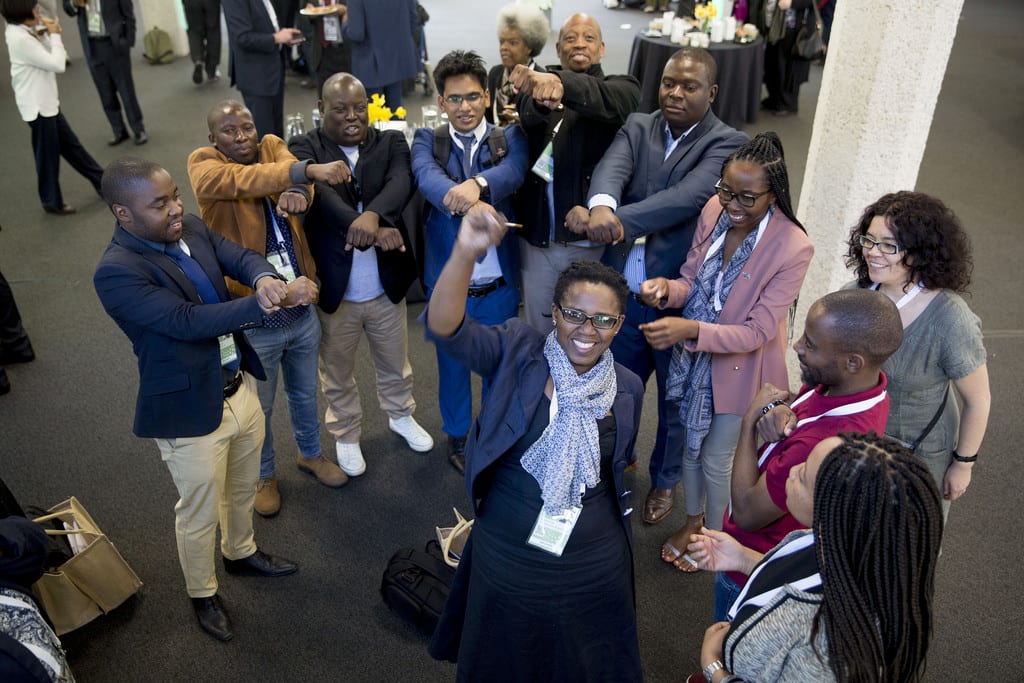
Above: Participants in the discussion on the intersection between gender and climate change in the Caribbean.

I was extremely pleased to meet a wide array of professionals involved in climate change action. From the media and communication specialists to the technical experts, and representatives, community-based and indigenous organisations, the participants were excited to partake in the discussions as we dived into the topic of gender relations in the Caribbean.

How is Gender linked to Climate Change?

Common opinion was that Caribbean society is not fully aware of the relationship between climate change and gender. According to the representative from the Institute of Gender and Development Studies at the University of the West Indies (Mona Campus), Kimberly Carr-Tobias, the core of the problem is the disproportionate access to the resources available to adapt to climate change impacts. She identified a clear gender gap in the Caribbean, which propagates the vulnerability of women.

‘Gender analysis allows for understanding gender roles and relations, recognition that there are gaps, identification of gaps, and leads to policymakers and practitioners using gender mainstreaming to achieve gender equality goals,’ Carr-Tobias highlighted.

‘The fact that women are traditionally placed at the bottom of the barrel increases their vulnerabilities to climate change.’

Imbalanced power dynamics between men and women determines who has what rights and who has what access to resources; resources needed to address climate change impacts.

The fact that women are traditionally placed at the bottom of the barrel increases their vulnerabilities to climate change. This affects how women are able to respond to climate change as their access to the necessary resources are restricted to their gender roles; roles which lack fluidity in the Caribbean.

Above: Participants in the discussion on the intersection between gender and climate change in the Caribbean.

Women from developing countries witness the nexus between climate change and gender issues on a first-hand basis. They are oftentimes highly dependent on the land and water resources for survival and are left in insecure positions. Climate change is not just an environmental issue, but links to social justice, equity, and human rights, all of which have gender elements.

Gender roles feed into the existing inequality and therefore the ability to deal with climate change impacts.

Group sessions allowed participants to benefit from in-depth analysis of the challenges which arise in dealing with gender and climate change in the region. A popular one identified – Human Resources. There needs to be the development of a pool of regional resources to deal with the issues at a regional level. Brain drain affects the ability of Caribbean people to address Caribbean issues at a regional level. In addition, due to the newness of gender/climate change as a concept in the Caribbean, many organisations are forced to look outside of their country for the experts to assist.

‘ Group sessions allowed participants to benefit from in-depth analysis of the challenges which arise in dealing with gender and climate change in the region. ‘


Above: Participants in the discussion on the intersection between gender and climate change in the Caribbean.

Correcting the imbalance

Vijay Krishnarayan, Director General of the Commonwealth Foundation, stated that governments on their own are not equipped to handle the issues related to climate change. Forging partnerships and collaboration is critical.

‘There needs to be dialogue, learning, and listening. The power relationships determine how action on climate change is played out and the success rate of projects to deal with climate change.’

We want to achieve meaningful involvement of vulnerable people in national discussions on climate change. People who are set to feel it the most are not involved.

As such, the Foundation’s goal over the two days was to ensure that less heard voices are put to the fore.

Gender is an all-encompassing subject which affects our society and must be included in the development of policy to boost effectiveness and broaden representation.

Strategic Gender Mainstreaming was also identified as a way forward.

Gender mainstreaming, established as a major strategy for the promotion of gender equality in the Beijing Platform for Action from the Fourth United Nations World Conference on Women in 1995, requires stakeholders to bring the perceptions, experience, knowledge and interests of women as well as men to bear on policy-making, planning and decision-making.

Key to addressing the gender and climate change issue therefore, is dealing with the detrimental disparity between men and women’s access to economic resources and the means of production.

As pointed out by David Bynoe, National Coordinator GEF SGP Barbados during the discussions, ‘It’s not about fragmented work but about building to make the overall impact better.’

I am certain I speak for my fellow participants when I say that the discussions were enlightening and necessary to help in the regional sharing of information as we continue to work together toward achieving participatory Caribbean governance.

Dizzanne Billy is the Caribbean Outreach Manager at Climate Tracker.


Marking memories at the Migration Museum

‘We are here because you were there’, declare black words on a yellow banner hanging from the ceiling at the Migration Museum in Lambeth, London – the location of the launch of We Mark Your Memory: Writing from the Descendants of Indenture  to which I’m delighted to be a contributor.

The words of A. Sivanandan – the late, great novelist and director emeritus of the Institute of Race Relations – could not be more poignant to the times we are living in and to the stories collected in the anthology. We Mark Your Memory is edited by David Dabydeen, Maria del Pilar Kaladeen and Tina K. Ramnarine, and is published by the School of Advanced Study in conjunction with Commonwealth Writers.

The Museum was the perfect location for the launch – a hidden gem filled with relics and memories of the extraordinary migratory journeys that humans have made across the world, and the racism and discrimination they have experienced. There are miniature models of multi-coloured boats and ships symbolising journeys made; there are records of the Rock Against Racism rallies and gigs; there is wonderful artwork and painting expressing migration.

It was against this fitting backdrop that speeches about the anthology from its editors and the Director-General of the Commonwealth Foundation, and six readings from the anthology, took place.

‘A collective act of resistance across time and space against having to explain to people their own British history’ and ‘a claiming of our identities internationally’, is how Maria del Pilar Kaladeen described the anthology. We Mark Your Memory commemorates the centenary of the abolition of the system in the British Empire (2017–20) by gathering, for the first time, new writing from across the Commonwealth that explores indentured heritage through fiction, essays and poetry.

‘What exactly is indenture?’, I am often asked by those brave enough to ask at all; others stare blankly when I mention the word indenture, assuming it’s something to do with teeth. And so I must explain the little-known system of nineteenth- and early twentieth-century Indian migration under the British Empire. Thankfully, I can now hand curious people a copy of the anthology. The abolition of slavery was the catalyst for the arrival of the first indentured labourers into the sugar colonies of Mauritius (1834), Guyana (1838) and Trinidad (1845), followed by the inception of the system in South Africa (1860) and Fiji (1879).

Indenture, whereby individuals entered, or were coerced, into an agreement to work in a colony in return for a fixed period of labour, was open to abuse from recruitment to plantation. Often-harrowing stories of exploited and unfree workers and their descendants are captured between the covers of the book. These include indentured histories from Madeira to the Caribbean, from West Africa to the Caribbean, and from China to the Caribbean, Mauritius and South Africa.

By the time indenture was abolished in the British Empire (1917–20), over one million Indians had been contracted, the overwhelming majority of whom never returned to India. Today, an Indian indentured labour diaspora is found in Commonwealth countries including Belize, Kenya, Malaysia, Sri Lanka and the Seychelles. There was a wide variety of geographical backgrounds represented in the six contributors who read:  Prithiraj R. Dullay read from ‘My Father the Teacher’, myself from ‘Escape from El Dorado: A Bittersweet Journey through my Guyanese History’; Fawzia Muradali Kane from ‘I go sen’ for you’; Gitan Djeli from ‘Mother Wounds’; Eddie Bruce-Jones from ‘india has left us’; and Priya N Hein from ‘Paradise Island’.

Finishing the readings, we were treated to a recital by acclaimed poet and writer Maria del Pilar Kaladeen of his first published poem in 23 years, ‘Pot-Bellied Sardar’, dedicated to his fellow editors. Amongst those celebrating the launch was esteemed poet John Agard. All in all, it was a most moving and memorable evening launching into the world an important book which sheds light on why we are here.

Access the full collection of images from the launch here.

Anita Sethi is a journalist and contributing writer to We Mark your Memory.

The value of a thousand narratives: reflections on the Commonwealth People’s Forum 2018

There I was, pacing the streets of one of the most impressive cities in the world. I was running late for an 8am meeting with a half-filled stomach, and my only concern was making sure I was well prepared.

For what? One of the most important political events on the Commonwealth calendar. More than 350 delegates from Commonwealth nations representing civil society were about to convene at the Queen Elizabeth II Centre in central London for the Commonwealth People’s Forum 2018.

Civil society is one of the biggest pillars of democracy. Through civil society those who have been repressed, violated, silenced and erased find a channel where they can tell their side of the story and hold governments to account for their commitments or lack thereof. Civil society is all about creating an enabling space for dissent which encourages multiple voices to be involved in policy-making processes. The governments may have the power, but the people collectively have a voice and policies that can be used to develop innovative solutions to some of the world’s most pressing development problems. Therefore, it’s very important that as many people as possible can be involved in creating solutions and as the saying goes ‘if you’re not around the table, you’re on the menu’.

A delegate asks a question during a panel on Legislative Reform in the Commonwealth
Photo©vickicouchman

For as far as I can remember I’ve always been an advocate for inclusion. When I’m not fighting for women’s rights to be recognized and a space to be created for them in political and economic processes, I’m challenging a system that has seen many young people being locked out of politics and other decision-making processes. So as per my self-appointed role, I was ready to scan the room and make notes on who had been left behind at this auspicious event.

‘The governments may have the power, but the people collectively have a voice and policies that can be used to develop innovative solutions to some of the world’s most pressing development problems.’

The opening could not have been more perfect. Ben Okri offered a satiating talk that allowed us to clean the palettes of our minds and hearts in preparation for the forum ahead. I say this because most of the time, especially when you have been to similar settings numerous times you start to feel that they are all the same. We start to look forward to the mistakes and what could have been done better instead of opening up ourselves to the possibility of having life and nation changing conversations.

Acclaimed author and poet Ben Okri opened the forum with a keynote on ending exclusion in the Commonwealth
Photo©vickicouchman

Many of us have struggled with the idea of a Commonwealth. The name suggests a common and shared wealth but this can be misleading considering that many of the citizens within these nations live below the poverty line. So what then is common amongst us? Mr Okri made me realise that what is common is our history and history has an invaluable amount of wealth, because of this we share a common story of how our nations came into being. We share a common language and also share similar future prospects.

‘The Commonwealth People’s Forum represented a dinner where everyone I could think of could be found at the table and for once instead of having the poor and marginalized on the menu, we had issues of corruption, sexism, racism and gender inequality to discuss.’

The Commonwealth People’s Forum was filled with people from all spectrums of life. Those who have attended many forums and those who were attending it for the first time. Like myself. Those who cared about the wellbeing of the elderly to those who were defending LGBTQI rights. Listening in on every session I got to walk in the shoes of the panelists as they shared their stories. This gave me a valuable insight on the challenges of inclusion and injustice others were facing across the Indian and Pacific Ocean.

From left to right: Patrick Younge, Rod Little, Rosanna Flamer-Caldera and Marchu Girma
Photo©vickicouchman

I always say the personal is political. Politics is not a choice. Often we use ourselves as the point of reference for our activism but this narcissistic approach to dissent can be reckless. The Commonwealth People’s Forum made me appreciate the value of a thousand narratives.

I come as one but stood for thousands that are unemployed in the Southern African Development Community (SADC). I speak for women that are violated and marginalised culturally, economically and politically. Making sure that the experiences and voices of all the ten thousand people and more that I represent are acknowledged is important to me. This made me notice another magical thing about the Commonwealth. We are a kaleidoscope of different hues, views, cultures and beliefs that are in conversation with one another. The Commonwealth People’s Forum represented a dinner where everyone I could think of could be found at the table and for once instead of having the poor and marginalised on the menu, we had issues of corruption, sexism, racism and gender inequality to discuss. Together we created solutions that have the power to drive the Commonwealth nations in the direction that the rest of the world should be going in.

Ian Mangenga is a youth activist and member of the South African chapter of the Southern African Alliance for Youth Unemployment

Commonwealth People’s Forum 2018: a case for renewal

2012 brings the Foundation back to the beginnings of its call for the renewal of the Commonwealth.

When the Foundation was re-launched in 2012 and given the mandate to support people’s participation in governance across the Commonwealth, the Commonwealth People’s Forum (CPF) was re-aligned to support this mandate.

In 2013 the CPF in Colombo, Sri Lanka contributed to the architecture of the Post 2015 Development Agenda and advocated primarily for gender equality and women’s empowerment as a stand-alone goal. That today is Goal 5 in the 2030 Agenda for Sustainable Development. The Malta Declaration on Governance for Resilience was the result of the conversations in CPF2015.

Even as CPF anchors itself in the prevailing development discourse, it does so by offering counter narratives, challenging dominant paradigms and giving meaningful access to voices in the margins. In Malta, CPF2015 offered the governance lens to the discourse of resilience, which until then was analysed only within an economic and environmental context.

‘CPF2018 interrogated the issues of exclusion in the Commonwealth, sessions took on injustice as experienced by people in all their diversity and tackled accountability in governance.’

It was also in Malta where the Commonwealth Heads of Government recognized the consonance of the work of the Foundation with SDG 16, the shorthand of which is Peace, Justice and Strong Institutions.

These are the building blocks of CPF2018. In 16 April 2018, the Commonwealth Foundation in partnership with the UK Government opened the doors of Queen Elizabeth II Conference Centre in London. It did so with defiant hope that renewal in and of the Commonwealth is indeed possible.

CPF2018 interrogated the issues of exclusion in the Commonwealth, sessions took on injustice as experienced by people in all their diversity and tackled accountability in governance. The forum pressed on to come to an understanding of the imperatives of a renewed Commonwealth. At the end of three days, civic voices crafted the London Declaration on Inclusive Governance for a Renewed Commonwealth with an accompanying Call to Action.

The Declaration and the Call to Action argue that Commonwealth renewal is no longer an option, but an achievable imperative. Civic voices concluded:

‘We stand at the threshold of a new Commonwealth future, built on equality, diversity, a constant questioning, and interrogation of the constraints and challenges that face us and the opportunities, strengths and values that unite us as human beings with shared stories.

We will achieve this through common effort, shared experience, action with vision and imagination, and by building inclusive, participatory, responsive and accountable systems of governance that leave no-one behind.’

In these perilous times, now more than ever civic voice matters. And it is with a buoyant optimism that the Foundation will persist with its commitment to support the call for the renewal of the Commonwealth for the interests of civic voices.

More voices for a fairer world.

The CPF2018 Declaration and Call to Action cover 13 key policy areas:

  1. Reforming colonial-era laws
  2. Accessing justice
  3. Rights of indigenous peoples
  4. Women negotiating peace
  5. Migration
  6. People centred health and education
  7. Climate justice
  8. Just world order and just economies
  9. Digital age, one that enables but also protects the peoples of the Commonwealth
  10. Separation of powers
  11. Accountability in development
  12. Decentralising power
  13. Media accountability

Myn Garcia is Deputy Director-General of the Commonwealth Foundation. 

EDITOR’S NOTE: A newsletter item which was hyperlinked to this article and circulated on 30 April 2018 incorrectly identified Myn Garcia as Director-General of the Commonwealth Foundation.

Commonwealth People’s Forum 2018 in pictures

Award-winning photographer Vicki Couchman provided photo coverage throughout the three days of the Commonwealth People’s Forum 2018.

The pictures are now available for download in high resolution from the Foundation’s Flickr and Facebook pages.

Members of the Southern African Alliance for Youth Employment and other delegates at the Forum. Photo©vickicouchman
Theresa May speaking at the all-forum plenary, Toward a Common Future.
Photo©vickicouchman
Marai Larasi speaking in the Institutional Racism panel on day 1 of forum
Photo©vickicouchman
HRH Prince Charles joined the forum to meet civil society activists and writers
Photo©vickicouchman
Poetry by Melizarani T. Selva, Kendel Hippolyte and Karlo Mila during the opening ceremony of the forum
Photo©vickicouchman
Hazel Brown and Vijay Krishnarayan during the closing address of the forum
Photo©vickicouchman

Continue to the full collection and free downloads 

So Many Islands: an anthology of stories from the Caribbean, Mediterranean, Indian and Pacific Oceans

Marlon James, winner of the 2015 Man Booker Prize, writes in his introduction to So Many Islands that the collection represents ‘real globalism’: ‘a glorious cacophony that seeks no common ground other than attitude. Stories and poems that exist in no other context than their own, characters who owe only to themselves, and writers who write with nothing hanging on their backs’.

Underlying these resolute words are the paradoxes of island living which James’s introduction continually emphasises: that the sea and the sky are at once ‘definers and confiners’; that ‘to be island people means to be both coming and going’.

So Many Islands—a collection of poetry, prose and non-fiction from the Caribbean, Mediterranean, Indian and Pacific Oceans—comes out of Commonwealth Writers’ work in the regions and has been developed alongside their partners. The anthology emerged from three aims: to animate the challenges facing islands, to provide platforms for less-heard narratives, and to offer development opportunities for emerging writers. Thirty of the nations of the Commonwealth are islands, and the project was evidently timely and required, soliciting responses from over 300 writers responding to an open call for stories, poems and essays.

Reflecting the simultaneous connection and separation of island geography, So Many Islands is published in three editions, by three presses, in three regions of the globe. In the Caribbean, US and Canada, it is available from Peekash Press. In Australia, New Zealand and the Pacific Islands, it is published by Little Island Press. And in the UK and Europe, it is published by Telegram.

In his foreword to the collection, editor Nicholas Laughlin notes how the stories ‘speak to each other across oceans. Their stories, their insights, their arguments, their jokes, their memories and their questions travel far on unceasing tides’. Such oceans have been crossed for the ten launches So Many Islands has prompted, arriving in Barbados, Bermuda, Fiji, Jamaica, New Zealand, Samoa, St Lucia, Trinidad and Tobago and, most recently, the UK. Co-editor Nahila Folami Imoja, reviewing the Barbados launch, discusses the ‘ripple effect of good literature’. Her aquatic metaphor, together with constant turns to the ocean in So Many Islands, reminds us that, in Laughlin’s words, the ‘very sea that insulates and isolates’ islands is also ‘the medium that connects’.

As the pieces in So Many Islands cross oceans, they also cross genres, forms, themes and voices. In the anthology, you will find love poems and protest poems, stories of innocence and innocence lost, and narratives of departure and return. There are pieces that tackle traumatic histories – from the aftermaths of transatlantic slavery to nuclear testing in the Pacific – alongside a delicate exploration of budding sexuality in Singapore, a comic account of a cricket match that becomes a drama of personality, and a lyrical return to a Pacific island guarded by four female deities.

James’s introduction references the legacies which ‘take [islands’] resources away’; So Many Islands showcases the rich literary resource in which writing from islands shares. ‘It takes a big mind, or at least a big worldview, to write from a small island’, he says. ‘Everything we write stands one foot on land, the other in the sea. We can’t help it: we’re from where the air is clear, so it’s almost impossible to think small’.

Bocas Lit Fest has produced podcasts with some of the Caribbean authors—Angela Barry, Tracy Assing, Heather Barker, Jacob Ross and Melanie Schwapp. They can be heard here:
https://soundcloud.com/bocaslitfest/sets/so-many-islands

Will Forrester is an Intern for Commonwealth Writers.