In Khyber Pakhtunkhwa (KP) women continue to face challenges to participate in electoral processes, including voting and running for elections. A survey conducted by Aware Girls during a previous Commonwealth Foundation funded project ‘Strengthening women’s participation in governance in Pakistan’ revealed some of the challenges that hinder women’s participation in electoral processes, such as difficulties in accessing polling stations, lack of permission from families to take part in civic, political and electoral processes and having to vote according to male relatives’ political decisions.
Project
Peace Direct and Aware Girls are strengthening the capacity of a network of women to engage with policy makers, state institutions and political parties to advocate for increased protection of women’s political rights. This is being achieved by organising and building the capacity of a Women’s Advocacy Network of 20 young women and supporting existing Citizens’ Committees to advocate for women’s political rights in order to seek ways to contribute to a better, more conducive environment for women’s political participation in Khyber Pakhtunkhwa.
The project is also raising awareness and mobilising young women and wider communities to increase public support for women’s political participation; this will include radio programmes and peer-to-peer education activities by young women to promote women’s participation in the general elections of 2018. By promoting dialogue and engagement between the network and Citizens’ Committees and decision makers, like the Electoral Commission of Pakistan. The project will seek solutions to accessibility issues for women at polling stations, and advocate for the collection of gender segregated data on elections. They will also approach representatives of political parties, including senior party leadership to advocate for changes to parties’ manifestos and practices to reflect support for women’s political rights.
By the end of the project, greater awareness of women’s political rights would have been generated among young women and communities. The network of women is expected to have secured relevant skills and experience to continue to promote women’s political rights after the project ends. It is hoped that advocacy initiatives by the network and the Citizens’ Committees will contribute to a more conducive environment for women’s participation in electoral processes in Khyber Pakhtunkhwa, thus resulting in greater participation of women in the general elections of 2018.
Aware Girls is young women led organisation from Khyber Pakhtunkhwa working for women empowerment, gender equality and peace in Pakistan. Its mission is to advocate for equal rights of women and to strengthen women’s capacity to enable them to act as agents of social change and women empowerment in their communities. The organisation has received international recognition for its work to promote young women’s rights, including awards by the Stars Foundation and by the Commonwealth.
Can stories told through the medium of films, short stories and poetry, change the way people perceive social problems and challenge deep rooted social issues?
High-profile journalistic exposés can trigger change. But how can citizens sharing stories of, for example, gender-based violence, influence public discussion on the issue? That’s the question the Commonwealth Foundation brought to International Civil Society Week 2017 (ICSW 2017), a global gathering of civil society organisations. ICSW 2017 took place in Fiji in December in honour of that nation’s position as chair of the recent climate talks in Bonn; the first time ICSW had been convened in the Pacific.
The Foundation’s approach to investigating the transformative power of stories was to produce three discussion events for ICSW 2017 predicated on the following themes: Gender and Justice; The Legacy of Indenture; and The Politics of Identity. Creative storytellers and civil society representatives were invited to come together and discuss the issues raised in films and written stories created as part of Commonwealth Writers’ capacity development projects for storytellers. The Foundation funded a total of eight climate and women’s-rights activists from the Caribbean and the Pacific to participate in these conversations and the wider forum.
‘From the Polynesian oral traditions of old to films streamed via the web today, stories capture and store human experience.’
In the first of three events, Gender and Justice, Katherine Reki played her powerful short film: My Mother’s Blood (2016). The film tells the tale of a woman that falls victim to the ravages of superstition, the loss of her land and livelihood and the son she leaves behind who plots revenge. Reki opened the discussion with a statement that resonated with the audience: ‘Why can’t films tell the story of our culture and history? Why does it always have to be Hollywood’s? I wanted to change that.’
My Mother’s Blood’s narrative focus on people led to an emotional response that brought the room to life. The event’s chair, Gabrielle Hosein, pointed out how this could be useful: ‘if we can touch enough people’s hearts, we can cultivate action.’ This is partly the advantage that storytelling has over other ways of talking about social issues.
‘[Stories] create human connections to the issues and experiences they are a vehicle for. And in doing so they can encourage and shape conversations in a way many political discussions cannot.’
But, as the subsequent events explored, it is not just the emotional impact of stories that give them currency. In the event on The Legacy of Indenture, Mary Rokondravu, a Fijian writer and former winner of the Commonwealth Short Story Prize, made an important point: ‘if we leave these stories behind, then no one learns, and no one hears’. Indeed, stories have always played this role. From the Polynesian oral traditions of old to films streamed via the web today, stories capture and store human experience, and not only through the narrow experiences of those lucky or great enough to make it into the history books. With the proliferation of the internet, as one audience member pointed out, opportunities for ordinary citizens to have their stories acknowledged are increasing, and social media plays no small part in this.
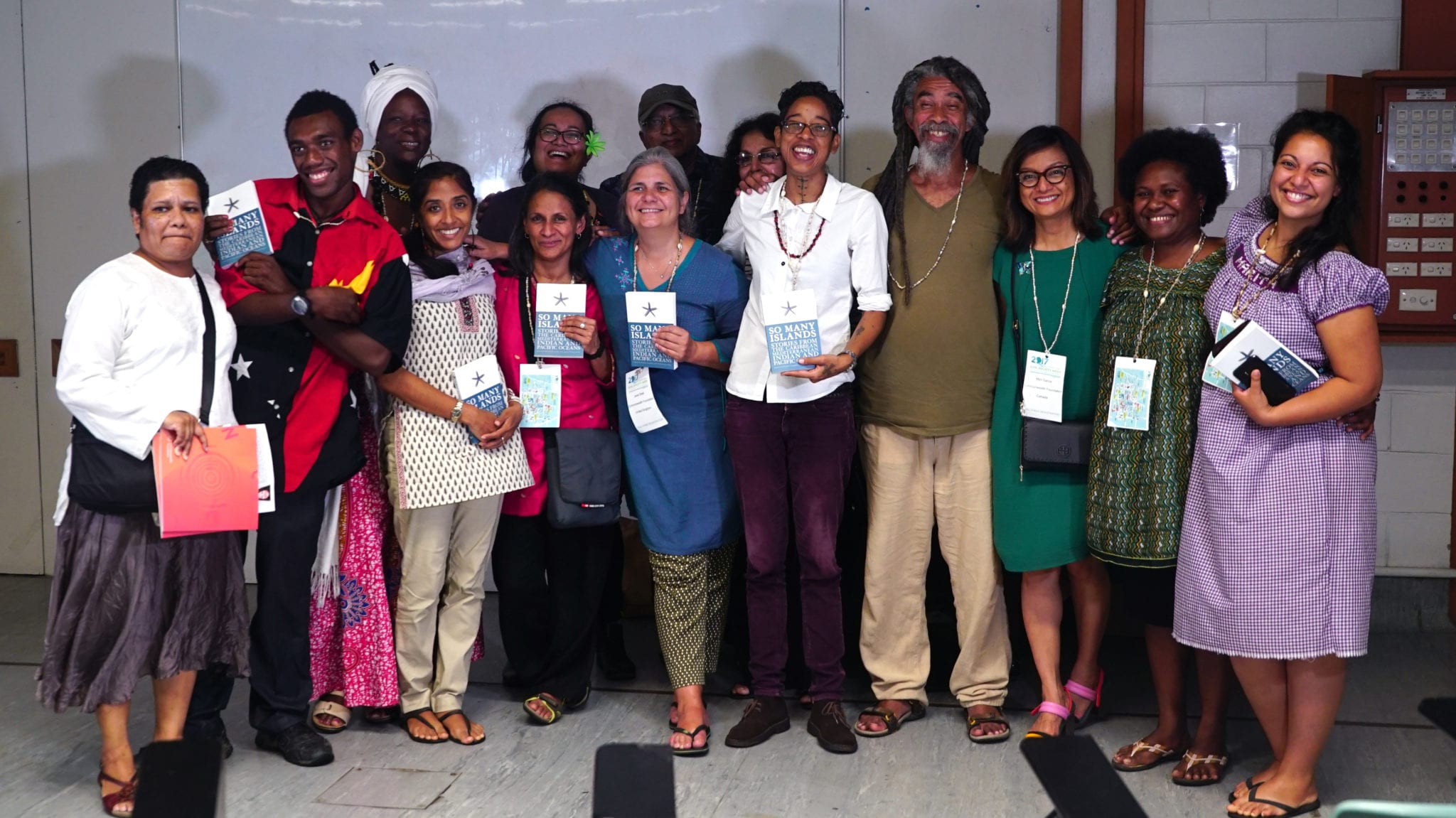
Above: Delegates from all over the world participated in the conversationsAbove: Part of the Foundation’s delegation to International Civil Society Week
The importance of stories as a means to preserve language and social identity was also discussed. Gabrielle Hosein emphasised that stories can give successors ‘a language to draw on’, enabling subsequent generations to create and sustain identities outside of the status quo. Mere Taito pointed out the importance of intellectual property laws in this debate: that social histories are written down is useful, just as long as they don’t find their way into ‘private vaults’.
.@rokonadravu2: In places w/ limited media freedom, that’s ‘where social media kicks in and fills in the gaps’. A key tool for telling those stories ‘otherwise subsumed in the broader national narrative’ #CWconvo#ICSW2017
At the concluding event, The Politics of Identity, Tracy Assing spoke of how indigenous histories were still not being ‘documented consistently or comprehensively’ and, with a glint of a tear in her eye, her performance of ‘Unaccounted For’, recently published in the Commonwealth Writers anthology So Many Islands, described how indigenous communities can attempt to undo this historical wrong: ‘I am the daughter of Ricky Assing and Marlene Ballantyne. The sister of Che […] this is how I was taught to introduce myself. It was a way of saying that I never walked alone’.
So, how do stories create change? They create human connections to the issues and experiences they are a vehicle for and, in doing so, they can encourage and shape conversations in a way many political discussions cannot. It was encouraging to see this idea picked up in the concluding ICSW 2017 plenary discussion on methods for civil society advocacy. But it was a subsequent comment from one of our panellists and former winner of the Commonwealth Short Story Prize, Mary Rokonodravu, which struck at the heart of the Foundation’s mission in Fiji:
Thank you @cwwriters – for voice, story, power to little islands and spaces, and for amplifying what would otherwise be impossible–the telling of fiction from my part of the world. https://t.co/N5eyGH5RMc
The Foundation’s Commonwealth Writers programme continues to identify platforms and to promote such stories from less-heard voices during 2018 and will be hosting several events at this year’s Commonwealth People’s Forum in London.
The theme: Our Planet, Our Struggle, Our Future. My heart raced as I blinked at the phone. I only had to confirm my attendance. I told no one at first. I was sure that if I spoke it, it would be somehow taken away.
In early November, another email followed. Subject: Trip to Samoa? The Ring of Fire was calling me. My story titled Unaccounted for, in the So Many Islandsanthology seen only by editors and printers, was going to come to life half-way around the world. Inside me a huge moon was beginning to wax.
For as long as I have known my voice I have thrown it to the Pacific. The area of our planet which is home to the most diverse range of indigenous cultures. I remembered reading about these islands and the Ring of Fire during my geography classes in Secondary school. The ring is dotted with 75% of all active volcanoes on Earth. It stretches from the southern tip of South America, along the coast of North America, across the Bearing Strait, down to Japan, into New Zealand and Antarctica. These islands were smack in the middle.
In July, at the Pacific Island Development Forum Leader’s Summit in the Solomon Islands, Fiji’s Prime Minister Voreqe Bainimarama said the government had accelerated plans to relocate some 40 coastal villages to higher ground. The land is suffering from ‘progress’ with unsustainable and rising natural resource extraction and chemicals and pesticides contaminating rivers but communities are working together to slow the dark and rising tides. I longed to join their resistance and wanted them to join mine. Our Planet, Our Struggle, Our Future our cause, the same.
‘It was my first chance to see what life is like on these islands, stories told by their storytellers’
‘That awkward moment when you get on the plane at 9:30pm on the 27 and get off at 6am on the 29.’ I tweeted as I struggled to stay awake during the six-hour lay-over at Nadi airport before meeting with Commonwealth Writers. We would travel on to Apia, Samoa together for the launch of So Many Islands, hosted by the Little Island Press. It was exciting to think of my work being included in this collection of poetry and stories from around the world.
On the drive from the Faleolo Airport to Hotel Vaea I considered the many similarities between my homeland and the landscape. The fale stood out and when I enquired I was immediately inspired. These simple, open huts were symbols of community and tradition. An open space where all were welcomed to be humbled and heard. The very presence of these structures seemed to underline the importance of community to me. I felt welcomed, embraced and supported by Tony Murrow and Evotia Tamua of Little Island Press, and Dionne Fanoti from the National University of Samoa. Then, I met Mere Taito, a Rotuman islander with a burning passion for storytelling and Katherine Reki from Papua New Guinea, a filmmaker and mother on a mission to create a better world for her children. Mere has written a fiery poem for the So Many Islands anthology and Katherine’s film My Mother’s Blood explores the killing of a woman, who is suspected of witchcraft, in the Highlands.
Above: Tracy reads Unaccounted For at the National University of Samoa, Apia, SamoaAbove: So Many Islands anthology, a collection of literature hailing from 17 island states in the Commonwealth, had its first regional launch at a ceremony in Apia, SamoaAbove: Tracy speaks to civil society representatives at the University of South Pacific, Suva, Fiji
In Unaccounted For I tell the story of my island and my ancestors. It is one story, the land and us. Intertwined before we became labour and the land became capital. It was an emotional experience, reading my story aloud for the first time, from its published pages to the small, attentive audience gathered in the hotel fale that Friday evening. My voice cracked just at the point where I welcomed my ancestors into the room and I was encouraged to go on by my new friends, who understood my tears and understood the struggles of my journey. I had travelled almost two days to get there. As I said my grandparents’ names, I felt their presence in the room. They were there to share that moment with me.
‘My truth is my identity, my right to declare that I belong, my right to practise and preserve my culture and celebrate my heritage’
The next day, we all attended a special screenings of six films from Tonga and Papua New Guinea produced by Commonwealth Writers. It was my first chance to see what life is like on these islands, stories told by their storytellers. We talked about that during the panel discussion that followed. How people who live on those islands and ours have been framed by those telling the story as documentary, as fantasy, and how important it is for us to tell our own stories. We have all been given the opportunity through the screenings of these films and sharing our stories in the So Many Islands anthology. So many islands separated and connected by water, even the water in our tears.
The story of indigenous people is not a story of decimation, it is a story of survival ! Huge applause from the room for @bonesnthegarden – our esteemed #SoManyIslands contributor #CWconvo#ICSW2017
On December 3, we arrived in Fiji for the International Civil Society Week. The team expanded. We were joined by Marita Davis, an I-Kiribati writer and Glenill Burua, a 19 year-old filmmaker from Matupit, Papua New Guinea. I joined Myn Garcia, Deputy Director General of the Commonwealth Foundation for a panel discussion at the University of the South Pacific on December 6 as part of the Commonwealth Writers Conversations series. From my story, Myn read the lines: ‘What did it all mean anyway? We had grown tired of the labels people had chosen to both recognise and erase us. Each label seemed to have the same purpose.’
Waxing still, we talked about recognition and cultural loss. In Trinidad, while descendants of the island’s first peoples received a one-off holiday in recognition of their presence last year, we have never been able to declare ourselves ‘indigenous’ on any census form.
My truth is my identity, my right to declare that I belong, my right to practise and preserve my culture and celebrate my heritage. With the publication of this anthology I have an opportunity to speak it out, clear across the planet. My message is clear and resonates. The indigenous story is one of survival. Our Planet. Our Struggle. Our Future.
Tracy Assing is a writer from Trinidad and Tobago.
In 2018 Commonwealth Writers and the School of Advanced Study, University of London, will jointly publish an anthology of poetry, fiction, and non-fiction which explores the legacy of the practice of indentured labour.
The Civil Society Forum, supported by the Commonwealth Foundation, takes place annually in Geneva prior to the Commonwealth Health Ministers Meeting and gives Commonwealth civil society a chance to discuss policy issues raised at the Commonwealth Health Ministerial Meeting (CHMM). This video provides a summary of the process and its potential value to participants.
With thanks to our contributors
Hon. John Boyce, Minister of Health, Barbados
Maisha Hutton, Executive Director, Health Caribbean Coalition
Prof. Tony Nelson, Commonwealth Health Professions Alliance
Anton Kerr, former Director of HIV/AIDS alliance and chairman of Commonwealth Health Professions Alliance, makes the case for increased spending on health. Photo credit: Leo Kiss
But will Ministers listen? That was the thought that nagged away throughout the short flight from London to Geneva as I travelled to attend this year’s Commonwealth Heath Minister’s meeting. They meet in the wings of the World Health Assembly and we work to bring civic voices to that Commonwealth ministerial gathering. Naturally civil society organisations across the Commonwealth have an interest in trying to influence the outcomes of the ministerial meeting. To do this we convened a policy dialogue at the Commonwealth Civil Society Forum that addressed the themes that would come up in the Commonwealth Health Ministers Meeting, which met under the banner “Sustainable Financing of Universal Health Coverage as an Essential Component for Global Security Including the Reduction of All Forms of Violence. But would they listen?
I came away from Geneva understanding that I had been asking the wrong question. It’s not a question of getting ministers to listen – rather the challenge is getting ministers, officials and civil society to talk with each other in order to find workable solutions to the health challenges we face. The approach we took this year was two-fold.
Firstly, we broadened the debate so that a wider cross section of civil society was able to participate in the discussion. Not only did this bring a Commonwealth agenda to a new audience – it also provided an opportunity for voices less heard to be given a platform. We convened a working group comprising the Commonwealth Health Professionals Alliance, Third World Network and the International Community of Women Living with HIV in Eastern Africa so that civil society organisations were designing and steering the process. They also delivered the three policy papers that formed the basis of the discussions at the civil society forum. Those papers included policy asks of Commonwealth Ministers. Those policy asks drew on the inputs of more than 100 other civic voices from across the Commonwealth through a survey. The process also drew in new stakeholders.
Secondly we deepened the discussion so that Ministers were provided with perspectives from civil society that they might not have considered or previously been exposed to. The three papers explored each of the strands on the Ministerial agenda: adding a gender equality dimension; exploring the utility of the concept of well-being; and provoking a discussion on the financing of universal healthcare.
The papers stimulated discussion in different ways. The paper by Saamah Abdallah on the Politics of Wellbeing challenged conventional metrics of development. It posited wellbeing as a sustainable condition that enables the individual to develop and thrive. Its holistic approach encourages ministries and agencies to collaborate. In data collected to date it seems there is a correlation between high levels of wellbeing in a population and “good” governance. The paper on structural violence and its impact on women’s health was powerfully delivered by Lillian Mworeko. She cited instances of forced sterilisation of women living with HIV. She made the point that when institutions visit this violence on women they foster discrimination and stigma and this despite progressive laws and policies. Tony Nelson presented on financing Universal Health Care. The provocative thesis suggested that spending more on health care doesn’t always result in better health outcomes and that greater accountability is needed on way that resources are allocated and spent.
But would Ministers listen? The chances of giving the issues raised by civic voices a proper airing is constrained by the format of the Ministerial Meeting so we invited policy makers to sit with civil society at the Forum and respond to the policy changes being suggested. The Minister of Health for Barbados, Hon. John Boyce provided new insights on the potential of alliances between civil society and Ministries of Health. He described moves to address sugar in soft drinks in Barbados, where collaboration had worked well. Dr Jabbin Mulwanda, the Permanent Secretary for Health Services in Zambia affirmed how helpful civic inputs were for civil servants charged with finding solutions to public health challenges. Their willingness to engage at the Forum helped to achieve our objective of dialogue. Without them the Forum would have been one more civic gathering and there are plenty of spaces where civil society can talk to itself. I know colleagues from governments valued the exposure and I dare say we enhanced their Commonwealth Health Ministerial Meeting experience.
We provided a Commonwealth space that encouraged the co-creation of new policy thinking in a collegial and informal setting. We went some way to making room for less heard voices and south-south exchange. The process worked well and everyone got a boost from the attendance and participation of the Commonwealth Secretary-General, Hon. Patricia Scotland QC. It was the first time that an SG had actively listened to what civil society had to say about the Health Ministers’ agenda and her assurance that the policy asks made would be given proper consideration was widely appreciated.
But did Ministers listen? The crude indicator in these matters is the final statement that Ministers issue at the end of their meeting. These statements are brief and summarise the main points. In the Commonwealth system they generally serve to signal intent rather than bind governments to specific commitments. Last year the Ministers’ statement included the line: “we note the civil society participation and contribution to discussions on sustainable financing and encourage their ongoing participation in health policy.” This was a disappointing result and perhaps responsible for that nagging refrain that wouldn’t go away – “Will Ministers listen?”
I looked at this year’s statement with hope restored. In paragraph 12: “Ministers noted the report from the Civil Society Forum Policy Dialogue which highlighted the need for a universal health system that provides basic minimum package of services to all as a key priority; emphasised well-being as core to health policy and being more than just absence of disease; and, raised the issue of structural inequalities and violence and their impact on the utilisation of healthcare.” This year it seems, at least the substance provided by civil society at its Forum had been registered.
Yes, Ministers of Health did listen to what civil society organisations had to say but now I was left with a new concern. If the priorities in the Ministers’ statement are going to be implemented – the position of Health Ministers in national administrations needs to be strengthened. My new question was “Does anyone listen to what Ministers of Health have to say?” Surely dialogue and alliances between health ministries and civil society for a common cause can only improve the chances.
At Wilton Park’s third meeting on ‘Peacebuilding in Africa’ series, participants were asked about the biggest opportunities or hindrances to sustainable civil society engagement in the African peacebuilding process.
Myn Garcia, The Commonwealth Foundation’s Deputy Director, spoke about the importance of localised civil society action to peaceful development and the need to acknowledge the multitude of national and local perspectives in the African context.
Previous events in Wilton Park’s ‘African perspectives on peacebuilding’ series have assessed the development of African approaches to peacebuilding in response to the changing dynamics of conflict and emergence of new conflict actors on the continent.
With support from the Commonwealth Foundation, the Civil Society Forum was jointly hosted by the Commonwealth Health Professionals Alliance, International Community of Women Living with HIV Eastern Africa (ICWEA) and Third World Network, and took place on 20 May 2017 prior to the World Health Assembly and in conjunction with the Commonwealth Health Ministers’ Meeting (CHMM).
Objectives: to present the Commonwealth civil society position on issues discussed at the Commonwealth Health Ministerial Meeting 2017, and produce a policy statement that will be heard by Ministers attending the CHMM 2017.
Methodology: The forum followed the format of a policy dialogue bringing together civil society representatives and policy makers. It included a presentation of policy briefs that are the result of a consultation process in which civil society voices throughout the Commonwealth were reflected.
The policy briefs presented to ministers can be downloaded below:
Convened by EASSI, the multi-stakeholder dialogue intended to present and discuss the findings of the pilot implementation of the EAC Gender Barometer and to lay the foundation and build partnerships for an evidence based advocacy tool for promoting gender equality in the East African Community (EAC). The Commonwealth Foundation supported the dialogue, which was held in Kampala in May 2017.
Under EASSI’s leadership the dialogue provided a space for civil society, government representatives from Kenya, Rwanda, Tanzania and Uganda as well as women’s rights activists to interact on the findings of the EAC Gender Barometer. Some of the highlights from the pilot:
Need for bold steps to address gender redistributive justice, and to reorient entitlements of women and men. All governments achieved low scores in this regard
Gender-based violence: need for issue based conscientization campaign and the need for accountability channels, where currently none exist.
Sexual and reproductive health and HIV/AIDS: there has been a reversal of gains in countries like Uganda; social responses need to be strengthened.
Rwanda taking the lead in institutionalising gender budgeting. Macro economic frameworks still largely impervious to gender and equity concerns
Good progress made on legislation; challenge is in implementation.
At the dialogue a government representative from South Africa offered the SADC experience on the use of the barometer in the Southern Africa region and spoke of how important the collaborative partnership to advance gender equality is.
In addition, five policy briefs based on identified gender priority issues were developed to include targeted policy recommendations on realisation of gender equality in the EAC.
Priorities for the way forward: 1) Popularising the Gender Bill nationally, 2) National ratification, 3) application of the Gender Barometer
Keep in touch
Discover grant and job opportunities, stories from civil society and updates on our work