Submit a thread to our digital quilt for the chance to be featured in an exhibition and win £200. Learn more

Tag: Creative expression

Message for Commonwealth Day 2018

This year the Commonwealth’s theme is ‘Towards a Common Future.’

It’s an aspiration which many would subscribe to; what distinguishes the Commonwealth’s commitment is a focus on making that future fairer for all.

For the Commonwealth fairness is a powerful concept. We invoke it, for example, in relation to the conduct of elections and the pursuit of a global rules-based trading system. But fairness also evokes other words that are keystones for the Commonwealth, like equity and justice. Through these lenses fairness also means sustainable development and universal human rights.

The Sustainable Development Goals (SDGs) saw the global community agree that we should ‘leave no one behind’. This means that each of us has a responsibility to each of us and that we all need a say in determining what’s fair. At the Commonwealth Foundation our strapline is ‘More voices for a fairer world’ because we recognise that inclusive, fair, and accountable development is best achieved through civic dialogue and participation.

‘The architecture of the SDGs acknowledges that fairness doesn’t just happen—it requires foundations.’

There is no universal template for achieving fairness within the Commonwealth’s broad vision for plural democracies where all can expect equal treatment. Any definition of fairness should respond to an articulation of people’s needs regardless of their status. The road to fairness is culturally situated and negotiated.

Civil society is an essential part of this mix. It is these voices that can bring the interests and concerns—particularly from those that aren’t usually heard—into the public arena, where institutions and policies can respond.  The architecture of the SDGs acknowledges that fairness doesn’t just happen—it requires foundations. SDG 16 calls for peace, justice, and strong institutions. These are the essential building blocks for sustainable development. Policies can signal the intent of institutions to encourage this kind of environment; at their best these policies are driven by or engage with civil society.

The Southern African Alliance for Youth Employment is bringing together organisations from seven countries, including trade unions, churches, and wider civil society to develop their ideas for policies that get young people working. The Eastern African Sub-Regional Support Initiative for the Advancement of Women is monitoring the commitments of East African governments on gender equality and has been advocating for a regional Gender and Development Bill.

‘An environment that encourages creative expression also has a part to play in enabling citizen voice and establishes a climate for fairness.’

The Commonwealth Human Rights Initiative from India and the Katiba Institute from Kenya are learning from each other to establish and strengthen Right to Information legislation. Transparency International Sri Lanka is doing the same, while the Network for Non-Governmental Organisations is informing the regulatory for civil society in Nigeria.

The Commonwealth Foundation supports these initiatives but also recognises that not all voices get heard through established and institutionalised ways and means. An environment that encourages creative expression also has a part to play in enabling citizen voice and establishes a climate for fairness. Anthologies of writing on small states or the experience of indentured labour encourages each of us to see through the eyes of others. Short films from new directors from Pacific Islands reveal issues of concern to new audiences.

These examples illustrate the ways in which civic voices help to determine what fairness looks like. They deepen our understanding of what fairness needs to deliver and shape the policies that will make it happen. Most importantly they help us to be true to the commitment to leave no one behind by amplifying those that are less heard. Without less-heard voices, ‘fairness’ only works for those powerful enough to define it, leaving others with a sense of grievance and injustice. ‘Governance that is inclusive and delivers development that is inclusive’: that’s what we mean by ‘A Common Future’ and it signposts Commonwealth renewal.

Vijay Krishnarayan is Director-General of the Commonwealth Foundation. 

Can stories create change? Commonwealth Conversations at Civil Society Week

Can stories told through the medium of films, short stories and poetry, change the way people perceive social problems and challenge deep rooted social issues?

High-profile journalistic exposés can trigger change. But how can citizens sharing stories of, for example, gender-based violence, influence public discussion on the issue? That’s the question the Commonwealth Foundation brought to International Civil Society Week 2017 (ICSW 2017), a global gathering of civil society organisations. ICSW 2017 took place in Fiji in December in honour of that nation’s position as chair of the recent climate talks in Bonn; the first time ICSW had been convened in the Pacific.

The Foundation’s approach to investigating the transformative power of stories was to produce three discussion events for ICSW 2017 predicated on the following themes: Gender and Justice; The Legacy of Indenture; and The Politics of Identity. Creative storytellers and civil society representatives were invited to come together and discuss the issues raised in films and written stories created as part of Commonwealth Writers’ capacity development projects for storytellers. The Foundation funded a total of eight climate and women’s-rights activists from the Caribbean and the Pacific to participate in these conversations and the wider forum.

‘From the Polynesian oral traditions of old to films streamed via the web today, stories capture and store human experience.’

In the first of three events, Gender and Justice, Katherine Reki played her powerful short film: My Mother’s Blood (2016). The film tells the tale of a woman that falls victim to the ravages of superstition, the loss of her land and livelihood and the son she leaves behind who plots revenge. Reki opened the discussion with a statement that resonated with the audience: ‘Why can’t films tell the story of our culture and history? Why does it always have to be Hollywood’s? I wanted to change that.’

My Mother’s Blood’s narrative focus on people led to an emotional response that brought the room to life. The event’s chair, Gabrielle Hosein, pointed out how this could be useful: ‘if we can touch enough people’s hearts, we can cultivate action.’ This is partly the advantage that storytelling has over other ways of talking about social issues.

‘[Stories] create human connections to the issues and experiences they are a vehicle for. And in doing so they can encourage and shape conversations in a way many political discussions cannot.’

But, as the subsequent events explored, it is not just the emotional impact of stories that give them currency. In the event on The Legacy of Indenture, Mary Rokondravu, a Fijian writer and former winner of the Commonwealth Short Story Prize, made an important point: ‘if we leave these stories behind, then no one learns, and no one hears’. Indeed, stories have always played this role. From the Polynesian oral traditions of old to films streamed via the web today, stories capture and store human experience, and not only through the narrow experiences of those lucky or great enough to make it into the history books. With the proliferation of the internet, as one audience member pointed out, opportunities for ordinary citizens to have their stories acknowledged are increasing, and social media plays no small part in this.

Above: Delegates from all over the world participated in the conversations
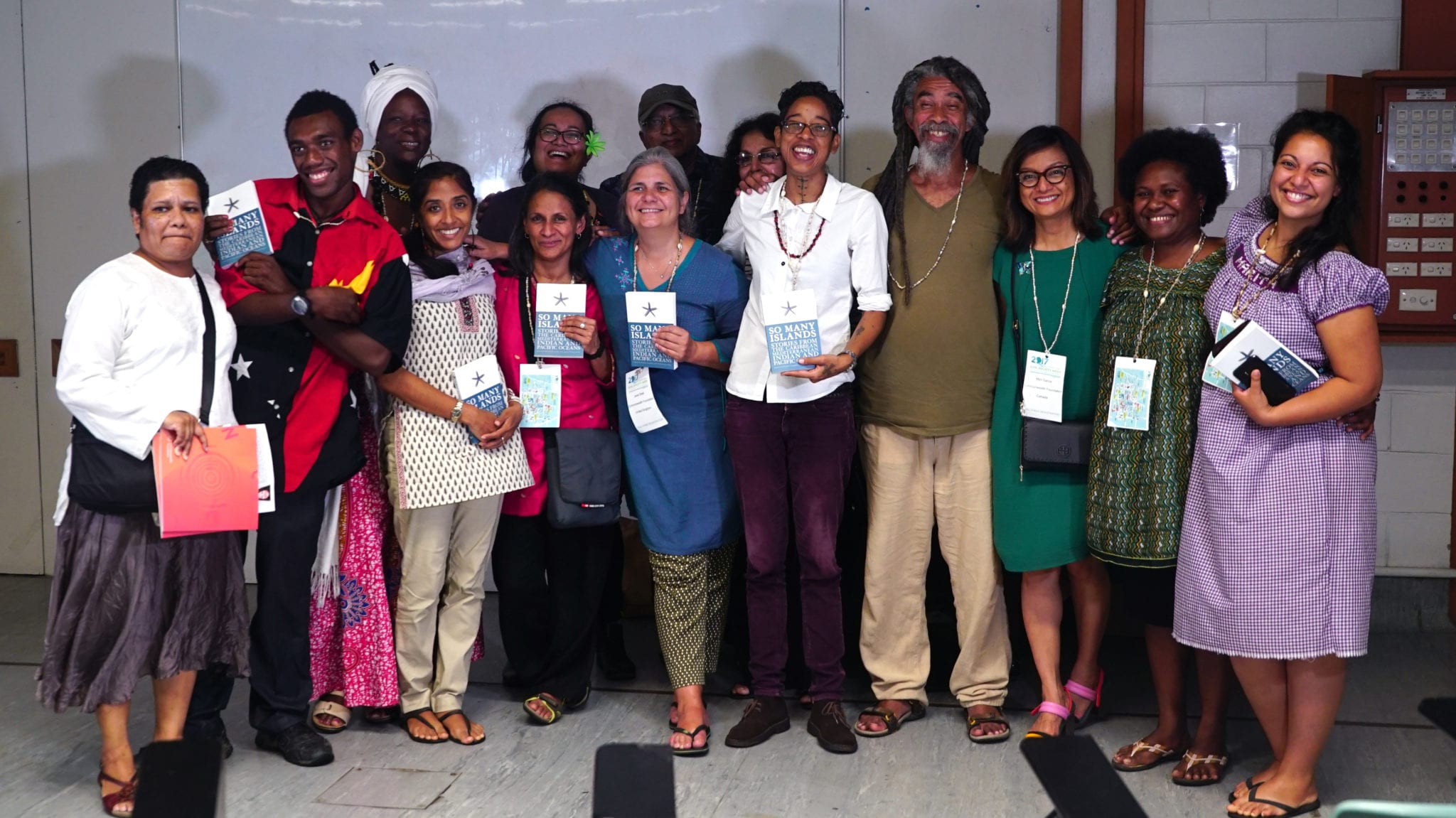
Above: Part of the Foundation’s delegation to International Civil Society Week

The importance of stories as a means to preserve language and social identity was also discussed. Gabrielle Hosein emphasised that stories can give successors ‘a language to draw on’, enabling subsequent generations to create and sustain identities outside of the status quo. Mere Taito pointed out the importance of intellectual property laws in this debate: that social histories are written down is useful, just as long as they don’t find their way into ‘private vaults’.

At the concluding event, The Politics of Identity, Tracy Assing spoke of how indigenous histories were still not being ‘documented consistently or comprehensively’ and, with a glint of a tear in her eye, her performance of ‘Unaccounted For’, recently published in the Commonwealth Writers anthology So Many Islands, described how indigenous communities can attempt to undo this historical wrong: ‘I am the daughter of Ricky Assing and Marlene Ballantyne. The sister of Che […] this is how I was taught to introduce myself. It was a way of saying that I never walked alone’.

So, how do stories create change? They create human connections to the issues and experiences they are a vehicle for and, in doing so, they can encourage and shape conversations in a way many political discussions cannot.  It was encouraging to see this idea picked up in the concluding ICSW 2017 plenary discussion on methods for civil society advocacy. But it was a subsequent comment from one of our panellists and former winner of the Commonwealth Short Story Prize, Mary Rokonodravu, which struck at the heart of the Foundation’s mission in Fiji:

The Foundation’s Commonwealth Writers programme continues to identify platforms and to promote such stories from less-heard voices during 2018 and will be hosting several events at this year’s Commonwealth People’s Forum in London.

Our shared vision: The Southern African Civil Society Forum

I graduate from law school in 18 months but since I was 16 years old I have been a child rights and youth activist.

As the only young Namibian voice at the recently concluded Southern African Development Community – Civil Society Forum (SADC – CSF), I felt strongly that I needed to make the voice of Namibian youth heard and to describe the complex issues facing Namibia’s young people and women. I attended as one of six country representatives from the Southern African Alliance on Youth Employment (SAAYE).

‘To attend meetings such as these, senior members of organisations have priority and it is difficult to source funds to participate.’

My experience at the forum was rich. I was eager to learn from delegates from a variety of civil society organisations about the work they do across the region and to engage in conversations around youth employment. The forum explored topics ranging from the rule of law, statelessness, sexual reproductive health and people living with disabilities, all of which have a huge impact on young people. Sexual and gender based violence, youth unemployment, inequality and poverty are regional predicaments, all of which are prevalent in Namibia. To me, the main lesson is that SADC needs to collaborate more, to plan and strategise on how to collectively solve the issues we all face.

The CSF is a unique platform. There are not that many events where civil society converge in the region to talk about the diverse problems we face. It was a pleasure to engage with participants that have been in advocacy for longer than I have and to learn improved ways of setting an advocacy agenda and how to engage with key players. The Forum is also a great opportunity for young people to voice their concerns, hopes and challenges. Through the stories shared, I saw many similarities in the hopes and challenges faced by my fellow youth across Southern Africa.

‘I could say I am the personification of Namibia because I am a young, black, 21-year-old citizen, which according to the 2011 census is the average Namibian person.’

It is a sad truth that young people in the region rarely have the opportunity to be participants and contributors to the development agenda of the region. To attend meetings such as these, senior members of organisations have priority and it is difficult to source funds to participate. Youth however make up 60% of the total population in the SADC region. I pointed out that a specific commission dedicated to youth might be needed.

My country Namibia, is very young and has a unique profile. I could say I am the personification of Namibia because I am a young, black, 21-year-old citizen, which according to the 2011 census is the average Namibian person. The forum added to my insight on shared identity by showing me it exists regionally too. A shared identity should help us find the right path toward creating the SADC we all want.

I am grateful to the Commonwealth Foundation and the Economic Justice Network for the collaborative effort in making it possible for me to be heard.

Emma attended SADC – CSF as one of six country representatives from the Southern African Alliance for Youth Employment (SAAYE), a project supported by the Commonwealth Foundation. 

Special event: writing the literature of Indenture and its legacies

To mark the centenary of the abolition of indenture in the British Empire, Commonwealth Writers is partnering with the School of Advanced Study, University of London, to host a high-level panel discussion with writers from across the indentured labour diaspora.

The panellists include the Award winning writers Ananda Devi (Mauritius), Gaiutra Bahadur (Guyana), Lakshmi Persaud (Trinidad), Mary Rokonadravu (Fiji) and Agnes Sam (South Africa).

The discussions will form a prelude to 2018, when Commonwealth Writers and the School of Advanced Study will jointly publish an anthology of poetry, fiction, and non-fiction which explores the legacy of the practice of indentured labour. They take place as apart of the Indenture Abolition Centenary Conference, jointly hosted by the University of Warwick and the University of London. To purchase tickets to the panel discussion, please visit the University of London Website.

Date
7 October 2017 – 18:15 – 21:00

Venue
The Beveridge Hall, Ground Floor, Senate House, Malet Street, London WC1E 7HU

The occasional hum of the Commonwealth Short Story Prize

ABOVE: Regional Winners in Singapore from left to right: Ingrid Persaud (for Caribbean region), Tracy Fells (for Canada and Europe region), Nat Newman (for Pacific region), Short Story Prize Judge Jacob Ross , Anushka Jasraj (for Asia region) and Akwaeke Emezi (for Africa region).


“And occasions being occasional, are a reason to hum…” It’s one of my favourite lines from this year’s group of regional Commonwealth Short Story Prize Winners and was crafted by Nat Newman in her short story “The Death of Margaret Roe,” which won the Pacific Prize. The line kept coming back to me as I watched people gather at The Arts House in Singapore to hear which of the five regional winners would be awarded the overall prize for 2017. There was definitely a hum in the air.

The Prize is a major feature of the Foundation’s work on creative expression and it’s delivered by our cultural initiative Commonwealth Writers, which inspires and connects writers and storytellers across the world. Well told stories can help us make sense of events, engage with others and take action to bring about change. The Prize itself was established in 2012 and built on the Foundation’s long tradition of awarding prizes for literature but offers something different to the array of other awards.

The Prize is awarded for the best peice of unpublished short fiction in English from the Commonwealth. As well as being open to entries translated into English from any language, it’s the only prize also open to entries in the original Bengali, Kiswahili, Portuguese and Samoan – to be joined by Chinese, Malay and Tamil in 2018. It’s free to enter and accessible to all writers – both published and unpublished. Speaking to winning writers in Singapore it’s clear that the key to the Prize’s growing popularity is that it provides an introduction to a global audience.

It’s judged by an international panel of respected writers, which represent each of the Commonwealth’s five regions (Africa, Asia, Canada and Europe, the Caribbean and the Pacific). This also sets the Prize apart as it’s truly international rather than judged in a geo-political centre. This year the judging panel was chaired by the Pakistani novelist Kamila Shamsie. She captured the essence of the Prize when she said of this year’s process “The judges weren’t looking for particular themes or styles, but rather for stories that live and breathe.”

The Prize goes from strength to strength. In its first year we received 2,000 stories from 42 countries. This year there were 6,000 entries from 49 countries and the shortlist list reflected this diversity with 21 writers from 10 countries making the cut. The regional winners came through a large and competitve field and it was a privilege to get to meet and talk with them and see them interact with each other – the mutual respect is palpable.

I think that’s the reason for the hum in the hall. The knowlegeable audience realises that they are in the presence of some of the most talented new story tellers:

  • Africa: Akwaeke Emezi (Nigeria) for “Who is Like a God”
  • Asia: Anushka Jasraj (India) for “Drawing Lessons”
  • Canada and Europe: Tracy Fells (United Kingdom) for “The Naming of Moths”
  • Caribbean: Ingrid Persaud (Trinidad and Tobago) for “The Sweet Sop”
  • Pacific: Nat Newman (Australia) for “The Death of Magaret Roe”

It’s noted that all the winners are women. In introducing the overall winner Jacob Ross – a member of the judging panel – suggests this is because the short story provides an accessible format and perhaps this is a space that’s been overlooked or vacated by male writers. Catherine Lim, Singapore’s most prolific writer of English fiction, was our guest of honour. She opened the envelope and read out Ingrid Persaud’s name to loud applause. I’m delighted that a fellow Trinidadian wins. Her story evoked language and images that would resonate with any Trini but her main theme of the complexity of the relationship between father and child is universal. Afterwards all the writers gather around to offer warm and genuine congratulations – they’re joined by last year’s winner Parashar Kulkarni from India and you can feel the sense of community that the Prize engenders. I wonder how such a competitive prize can engender this kind of fellowship.

Vijay Krishnarayan and Overall Commonwealth Short Story Prize Winner 2017 Ingrid Persaud

As we pack away I reflect on the enormous amount of work that my colleagues have put into making the awards evening such a success. They’ve also benefited from the help of several partners. The Arts House in Singapore provided a wonderful venue and the Holiday Inn Express Clarke Quay accommodated the writers and our staff. The National University of Singapore’s Centre for the Arts provided excellent musicians and dancers who helped interpret the readings of excerpts from the five stories by the authors. The National Arts Council of Singapore gave good advice and guidance. These in-kind contributions are priceless but we also need financial sponsorship to keep running the Prize and continue to improve it. This year we benefitted from the contributions from the Jan Michalski Foundation. The search for sponsors is underway and the hum for the 2018 Prize has started to build…

Ophelia by Breanne Mc Ivor

Ophelia’s words are sprinkling, tinkling in my ears. They smell like cut grass just washed with rain. I want to breathe her. Strip her. Peel her skin like sunlight strained through cinnamon and get to the heart of the woman that is buried under her layers of poise.

We are at rehearsal in the sprawling National Academy for the Performing Arts. The empty red seats roll back in waves before us. Ophelia is on her cell phone, making arrangements to go to the spa.

I wait until she hangs up. “Ophelia?”

“Yes?”

I want to lean forward and press my fingers on the hardness of her collarbone before pulling the plumpness of her bottom lip between my teeth. A kiss, I imagine, would start slow and rise in crescendos.

“Marcus?”

“Yes?”

“You called me?”

“Oh, yes.”

She sits on the stage, script spread out before her with all her lines meticulously highlighted in yellow. She is not wearing stage make-up but she already looks like the lead actress.

How could a woman named Ophelia not be an actress? I wish we were performing Hamlet. She would be herself, of course, peering out at me from the wings.

I can hear myself. To be or not to be– that is the question. My words are the choking smoke that heralds the start of a fire. Whether ’tis nobler in mind to suffer–

“Marcus?”

“Sorry.”

Ophelia’s forehead crumples. “I was wondering if you wanted to meet to brainstorm on Saturday? I still think we can work on our first scene together?”

Ophelia whips her phone out of her purse. Her fingers find her calendar. The light illuminates her face as she opens it. “What time on Saturday?”

“One?” I say, hoping. Hoping… Please God. Give me this. Give me this one thing. Give me an hour with this woman in a coffee shop. Give me her hair, twisted into ringlets that sink into one another. Give me the stomach-shudder when her shirt slips off her shoulder and I see her flesh crossed by a bra strap. Give me–

“Can you do one-thirty?”

I can do anything you want.

“Marcus?”

“Yes, of course – Jardin in the mall?” I try to say this as if I’m just flicking the words out of my mouth; as if I am the type who goes to Jardin des Tuileries instead of Tecla’s Vegetable Stand where I would haggle over the price of an avocado.

“Sure,” Ophelia says. “That sounds like a treat.”

Could she hear the vibrato in my voice? Would she taste my desperation if we kissed? That sour, morning-after taste that I can never brush out of my mouth? I won’t mess it up; I won’t think crazy thoughts in my head – all mixed metaphors and fantasies spilling from one part of me to another while I remain tongue-tied.

“Great,” I say. “I’m looking forward to it.”

Ophelia tucks her curls behind one pixie-pointed ear. Touching her would feel like the sun hitting my face first thing in the morning, like a piccolo playing notes that hum in my throat, like waking up after eight hours sleep.

Already my head-voices are telling me that this is madness. How could somebody like Ophelia – how could somebody like her – ever want anything to do with me? She probably rolled her eyes when she first saw my name on the cast list.

Ophelia smiles – more a lifting of the lips – before returning to her script. Already, her lines are consuming her. Our director wants us to spend ten hours simply reading the lines, and living the characters before we begin performing, but I can already see her weaving her character’s clothes over her own. Her pink dress – which only a moment before was elegantly gathered around her wasp-waist – seems to hang off her frame as if she has made herself thinner.

I return to my script and try to ignore her. I imagine my character as he is portrayed in Act One: young, grasping – a ghetto youth determined to claw his way out. Not such a hard thing for me to be. I even look the part – dark and scrawny like a weed springing up from a pavement crack.

Continue reading…