










Written piece
"The Sound of Forgotten Land" by Debashis Chakraborty
Debashis Chakraborty
India
About this piece
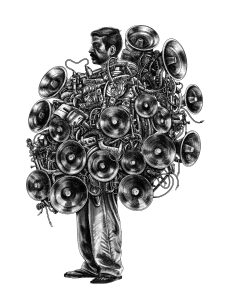
A hospitalized man's fading memory parallels an indigenous man's struggle to recall his father's anti-colonial theatre songs. Their shared amnesia highlights the tragic erasure of marginalized histories and oral traditions, symbolized by a silenced banyan tree.
The Sound of Forgotten Land
I can no longer recognize anyone.
It’s not as though I’ve reached the age of dying, nor even middle age. Yet why is this happening to me? Why can I no longer recognize people?
Just a while ago, a man came and introduced himself as my father. Why did I feel, with unsettling certainty, that he was nothing but a greedy man? Why did it seem to me that all his life he had done nothing but drive stakes into the ground—claiming every inch of land he could lay his hands on?
Why are such strange thoughts flooding my mind without reason? Am I losing my sanity? Have they admitted me into a mental asylum?
Through the window of this hospital, in the late afternoon, I see a sun like the yolk of an egg—astonishing in its stillness. At that hour, the sky wraps itself in pale blue clouds, and the sun wanders slowly across the vastness. This is my mother’s favorite color—the tender hue of the dying day. The moment I remember this, I feel an immense relief. That means my memory has not entirely abandoned me. I am not insane.
I clearly remember: once, with an entire team, I had gone to a tea garden to shoot a documentary on marginalized people. The cameraman had said, “Dada, this man hasn’t eaten for three months—he’s in perfect dying condition. Look how the flies swarm over his face. If we take a big close-up, the shot will be extraordinary.”
What I replied to him—I can no longer recall.
Damn it, what nonsense am I rambling! Why am I feeding this imaginary cow of a story chilled beer for my own amusement? The cameraman never said any such thing.
It was the man himself—the marginalized one. Yes, what was his name? Yes—Madhu Soren. He had said, “What kind of theatre do these boys perform now? Theatre was what our fathers did. Under the light of kerosene lamps, with painted faces, my father would shout—‘Sahibs, we will not give you a single piece of land!’”
Then he had said, “Now even in theatre, the tribal man speaks like you city babus from Kolkata.”
After taking a slow drag from his bidi, he pointed with his finger and said, “Look there—that big banyan tree. It has grown old now. My father planted it. Even today, when I look at it, my body warms up. My father used to say—the leaves of the banyan remember the past. They sing.”
I had asked him, “What do they sing?”
He replied, “The songs my father and his people sang in theatre—songs that struck the heads of landlords and officials like the blow of a spade—the tree sings those songs too.”
“Can you sing one of those songs?” I had asked, switching on the sound recorder.
The man had only closed his eyes and scratched his head. He could not sing.
Now I understand—perhaps that day, he too was searching for his memories. Just as I now lie on this hospital bed, searching for my past, he too must have been searching for his.
The moment I think this, I see a tunnel forming on the screen of my eyes. I realize, with terrifying clarity, that he and I are both trapped inside this strange tunnel. There is not a single drop of light. Breathing becomes difficult. The suffocation grows unbearable.
I can hear the hiss of snakes.
And I understand—this tunnel has been carved out by cutting down that banyan tree—the one that could sing