For the Pacific, climate change is not a distant threat. It is already reshaping the lives of our communities. It is taking homes and livelihoods, threatening food and water security, degrading ecosystems and, ultimately, putting at risk the cultures and identities that connect our people to their land.
For me, that is what makes climate change an issue of justice.
Those who have contributed least to the climate crisis are often facing its most severe consequences. Young people are being asked to inherit a crisis they did not create, while communities on the frontlines are left to adapt with far fewer resources than those most responsible for it.
But climate justice cannot be about seeing these communities only as victims. Across the Pacific and throughout the Commonwealth, people are already providing solutions. They are protecting ecosystems, developing new approaches to resilience and demanding greater accountability from those with the power to act. Our task is not to speak for these communities, but to ensure they have the resources, influence and platforms to shape the decisions that affect their future.
This requires an all-hands-on-deck approach.
I saw what this can look like in the campaign that led to the International Court of Justice’s advisory opinion on climate change. What began as an idea among students grew into a movement that brought together young people, governments, lawyers, academics, artists, communicators and frontline communities. Its strength came from people bringing different forms of knowledge and expertise together around a shared objective.
Often in the discussion on the campaign, one very important component can sometimes be left out—genuine collaboration with communities. We worked to gather stories from affected communities and individuals to attach to state submissions as testimonies presented to the Court. These stories were absolutely important in ensuring that the ICJ heard directly from the people who were living the climate crisis, and who stand to lose the most as it continues. What was even more significant was that these testimonies brought culture, custom, rituals, and traditional knowledge before the Court in a truly human demonstration that is rarely seen. It was the collaboration between the stories of people, their lived realities, and the law that made this case so unique.
‘This was the Pacific Way of doing things, where we all gather to lend a hand, support, and help shoulder the burden.’
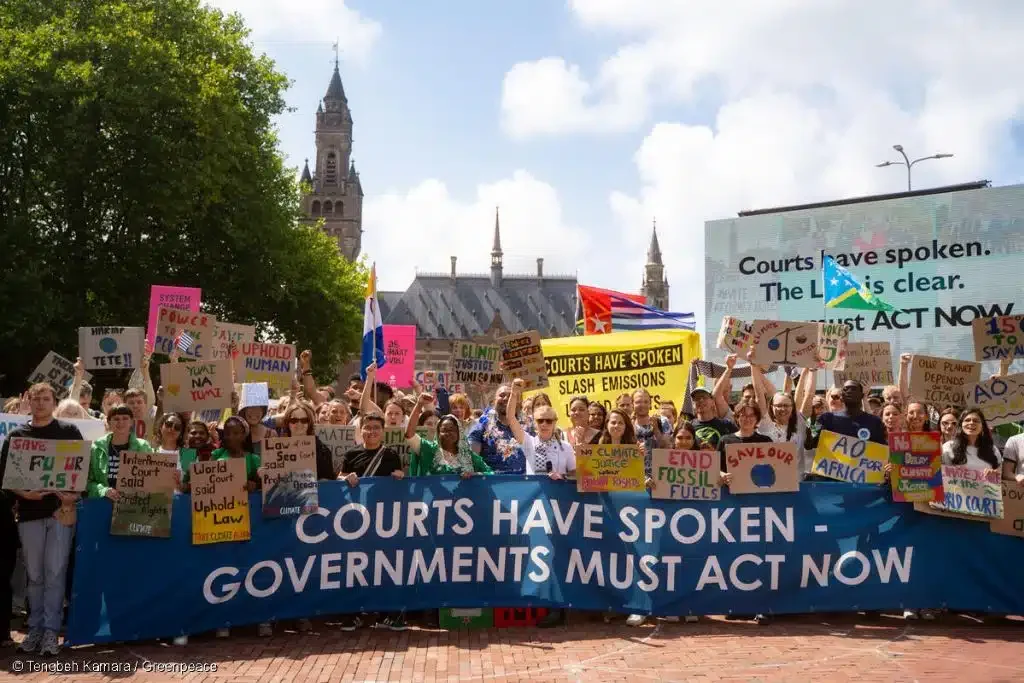
Even during the oral hearings in The Hague, that collaboration was visible every day. While the legal teams tracked submissions and supported states in real time, artists, organisers and communicators built a Pacific space across the city, with exhibitions, ceremonies, a People’s Assembly, art builds and projections on buildings. The people whose futures were being argued over inside the courtroom were present, visible and impossible to ignore outside it. This was the Pacific Way of doing things, where we all gather to lend a hand, support, and help shoulder the burden.
We need that kind of deep collaboration across the climate justice movement. Climate change does not sit neatly within one policy area. It intersects with human rights, inequality, biodiversity, migration, livelihoods and energy. Part of what made the ICJ campaign work was that we deliberately framed it not only as an environmental issue, but as one of human rights, self-determination and the legacy of colonialism. Breaking down the silos between movements can help us see these connections and build stronger responses.
‘Young people and their communities already hold enormous power. The challenge is creating the conditions for that power to be activated.’
Young people have a particularly important role to play. We often talk about empowering young people, but young people and their communities already hold enormous power. The challenge is creating the conditions for that power to be activated. That means education, capacity-building, funding and genuine opportunities to participate, not simply inviting young people into conversations once the important decisions have already been made.
The same principle should guide international action. Climate-vulnerable countries and communities need partners who will support their leadership rather than replace it. That means making climate finance more accessible, investing in grassroots organisations and ensuring that local and Indigenous knowledge is valued alongside technical and scientific expertise.
International commitments and legal developments can provide important foundations for this work. The ICJ advisory opinion is one example. When the Court delivered its unanimous opinion in July 2025, it confirmed that states have binding obligations under international law to protect the climate system from greenhouse gas emissions, and that breaching them is an internationally wrongful act with legal consequences, including reparation. That has strengthened the legal basis for demanding accountability. In May 2026, 141 states voted for a UN General Assembly resolution taking the opinion forward. But the real test is what happens next—whether those commitments translate into stronger national action, greater resources and meaningful change for people on the ground.
‘The call to use every possible tool, every possible avenue, to address this emergency could not be overstated.’
The Commonwealth can play a vital role here. It brings together many of the world’s most climate-vulnerable small states, including Pacific countries that championed the ICJ campaign, alongside some of its largest economies. That gives it a rare ability to bring countries and civil society together, strengthen capacity and help amplify the leadership of those already at the forefront of the climate justice fight. In doing so, it can also support and champion the very important work of operationalising this historic Opinion. If we do not, then we fail to use a hard-won tool to fight for justice. The alarm bells are already ringing as we head towards a world that overshoots 1.5°C and the call to use every possible tool, every possible avenue, to address this emergency could not be overstated.
Climate justice is ultimately about the future we leave to the next generation. When we started in 2019, we were a group of students with an idea. What took it all the way to the Peace Palace was not any single institution or government, but people from every walk of life choosing to carry it together. The same is true of the climate crisis: we cannot solve it through one institution, one agreement or one movement. But if we work across generations, borders and sectors—and put those most affected at the centre—we can build a response that is not only more effective, but fairer.
Vishal Prasad is the Director of Pacific Island Students Fighting Climate Change.