

For over a decade, the Commonwealth Short Story Prize has celebrated the best unpublished short fiction from across the Commonwealth. Each year, thousands of writers take up the challenge, but learning how to write a compelling and engaging short story can be harder than it seems.
As entries opened for the 2026 prize, we invited previous winners and judges to share practical writing exercises and short story prompts to help writers plan and develop their story.
This article brings together four ten-minute writing prompts designed to inspire your storytelling, strengthen your creative process, and build confidence as a writer:
- How to start a story
- Bringing characters to life
- How to structure your plot
- How to edit your story
Whether you’re preparing an entry for the Commonwealth Short Story Prize or simply looking for creative writing inspiration, these prompts will help you get started.
How to start a story
Chanel Sutherland, 2025 Overall Winner
Starting writing is often the most difficult step. It can be challenging to have confidence in your voice. Chanel Sutherland, the overall winner of the 2025 Commonwealth Short Story Prize, has advice for finding your flow and trusting your intuition and confidence as a writer. Her winning story sought inspiration from her ancestors, harnessing her own perspective on the world.
Prompt #1: How to start a story
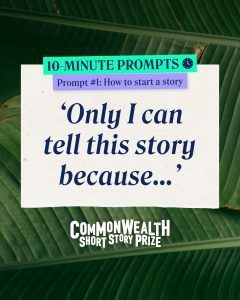
Write for 10 minutes (without stopping to edit) in response to this sentence:
‘Only I can tell this story because…’
Don’t worry if the answers feel too small, strange, or ordinary. Let it expand: What have you seen that others haven’t? What moment, image, or sound has stayed with you that no one else could describe in quite the same way?
Try to get specific: write about a single object, memory, or detail that lives only in your experience.
Using Chanel’s prompt helps to shift focus away from ‘big’ ideas to authentic ones, and reminds writers that our lived experience is enough. Take the raw material you create and use it to sow the seeds of your next project.
Bringing characters to life
Joshua Lubwama, 2025 Regional Winner for Africa
With the beginnings of a story, you can turn your mind to the characters who might populate it. Joshua Lubwama, 2025 Regional Winner for Africa, prioritised characterisation in his story. He was inspired by Toni Morrison, who wrote that ‘The plot is the character, the character is the plot’. Bearing these words in mind, he created complex, dimensional and truly interesting characters in his winning story.
Here is a 10-minute exercise to help you build nuanced characters.
Prompt #2: How to bring your characters to life
-
-
-
-
-
-
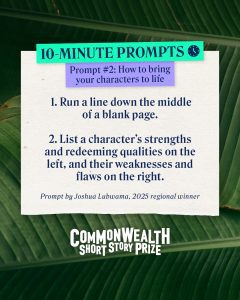
- Run a line down the middle of a blank page.
- List a character’s strengths and redeeming qualities on the left, and their weaknesses and flaws on the right
-
-
-
-
-
Contradictions help to make characters feel truly human. Complex or even unlikeable characters can evoke the strongest feelings of empathy from readers. Consider which qualities you find endearing or annoying in people and use this to breathe life into your characters. Consider also their habits and idiosyncrasies. What strange details might help to personify and make your characters feel memorable and unique?
How to structure your plot
Louise Doughty, Chair of 2026 Judging Panel
With fleshed-out characters and the beginnings of a story, what follows is the question of ‘what happens next?’ Setting up the structure of your story and crafting a narrative can be a daunting task. Louise Doughty, author and Chair of the 2026 Judging Panel, has a prompt to use a single word to develop an interesting plot.
Prompt #3: How to structure your plot
-
-
-
-
-
-
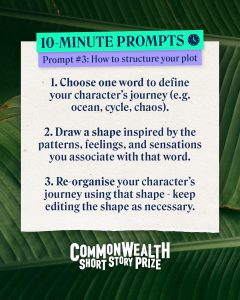
- Choose one word to define your character’s journey (e.g. ocean, cycle, chaos).
- Draw a shape inspired by the patterns, feelings and sensations you associate with that word.
- Re-organise your character’s journey using that shape – keep editing the shape as necessary.
-
-
-
-
-
There is no single right way to structure a story, with endless possibilities for creating your narrative. Look to what surrounds you – natural environments, cultural contexts and personal experiences.
How to edit your story
Faria Basher 2025 Regional Winner for Asia
Producing a draft is only part of the story-writing process. With a full story in front of you, your job now shifts from writing to editing. For short stories with limited space, this is especially important. Every word you put onto the page must earn its right to be there. Faria Basher, 2025 Regional Winner for Asia offers guiding questions to consider when editing your short story.
Prompt #4: How to edit your story
-
-
-
-
-
-
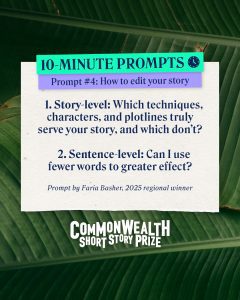
- Story-level: which techniques, characters, and plotlines truly serve your story, and which don’t?
- Sentence-level: Can I use fewer words to greater effect?
-
-
-
-
-
A draft is the place for all your initial ideas to seed and grow, a rich, fruiting garden for you to explore all the possibilities of your story. Editing, on the other hand, is a process of refining, weeding and shaping. Be ruthless and unafraid to cut back on your words, ensuring that everything has intention to form a cohesive, harmonious whole.
It might be a cliché, but it’s true. When editing, don’t be afraid to kill your darlings. It may feel painful at first to cut out your hard-written words, but your work is likely to be better for it.
Thank you to Chanel, Joshua, Louise, and Faria for sharing these prompts.
We hope you find them useful, and we look forward to reading your work when the prize opens in September.


